
«At our editorial desk, we prioritize verified facts, transparent mechanics, and compliance over aggressive marketing promises. Before placing any stake in crash games like Aviator, players must understand how the multiplier distribution works, test the demo mode safely, and establish strict personal limits.» Nadiya Farzana Huq, Editor-in-Chief, iGaming Bangladesh
Aviator Game: How to Play, Test the Demo, and Evaluate a Casino Offer
Provider
Spribe
RTP
97%
Volatility
High
Min bet
0.10
Max bet
$100
Max win
$10,000 per bet


Last fact-checked and updated: June 2026 · Reviewed by: iGaming Bangladesh editorial desk · Audience notice: 18+ only.
Understanding the Aviator game starts with separating three different things: live sports entertainment, RNG mechanics, and marketing offers. They are often mixed together in the same banner. As online entertainment options expand in regional markets like Bangladesh, readers who want analysis rather than hype need a plain breakdown of how playing Aviator actually works, how the aviator demo compares to funded play, and how to read an aviator casino offer without buying into unrealistic expectations.

Three Facts to Read Before You Play
- The crash point is pre-generated, not reactive. Every round of the aviator game is decided by a Provably Fair hash before the plane takes off, so no past coefficient, "hot streak", or Telegram signal can predict or shift the outcome.
- The demo uses the same math, not easier math. In licensed software, aviator free mode runs the identical RNG and 97% RTP model as aviator real money mode. What changes is your emotional exposure, not your probability of winning.
- Stake sizing beats multiplier hunting. Roughly 70% of rounds survive to 1.30x-1.50x, while 10x and above occurs in under 9% of rounds. Disciplined bankroll rules (1-2% per round) preserve playtime, but never guarantee profit.
Quick Glossary: Crash-Game Terms Used in This Guide
Before the mechanics, a short vocabulary check. Most confusion around crash titles comes from words used loosely in chat rooms and affiliate blurbs.
- Crash game. A format with one random terminal event per round. A value grows, then stops without warning. Aviator is one of the best known examples of the category.
- Multiplier (coefficient). The number your stake is multiplied by at the moment of cash-out. It starts at 1.00x and rises continuously.
- Cash-out. The single decision available to the player. Press it in time and the stake is paid at the shown coefficient; miss it and the bet is forfeited.
- Auto cash-out. A pre-set instruction stored on the operator's server. It fires at your chosen coefficient even if your phone freezes.
- Provably Fair. A cryptographic commitment scheme using server and client seeds, so a round result can be re-checked afterwards with a public SHA-256 tool.
- RTP and house edge. RTP is the theoretical long-run return, 97% in the official Spribe client. The remaining 3% is the operator margin, and it never disappears.
- Volatility. How widely results scatter around that average. Aviator's volatility is the reason short sessions feel wildly different from the published RTP.
- Bankroll. The total amount you have consciously set aside for entertainment, decided before the game opens.
- Wagering requirement and game weighting. How much turnover a bonus demands, and what share of your Aviator turnover counts toward it.
- KYC. Identity verification required by licensed operators before withdrawals.
Keep this list nearby. Half the "systems" sold online collapse the moment these terms are used precisely.

What Is the Aviator Game and How Crash Mechanics Work
In two sentences: Aviator is a Spribe crash game where a multiplier rises from 1.00x until a cryptographically pre-determined crash ends the round. Your only decision is when to cash out, because the crash point itself is fixed before takeoff and cannot be influenced.
The Aviator game is a social multiplayer crash-style casino title developed by Spribe, where an increasing multiplier climbs from 1.00x alongside a flying plane until an unpredictable crash ends the round. The outcome of every round is determined by a Provably Fair algorithm built on cryptographic seed hashes, which means neither the operator nor the player can move the crash timing after betting opens.
«Crash games are built on random number generators that produce a negative expected value corresponding to the advertised house edge.» Scott, Sher & Daigle, Cash or Crash: Return to Player Percentages and Expected Value of Crash Games, Journal of Gambling Studies (2026, online-first release). https://doi.org/10.1007/s10899-026

In this format, aviator is one of the most visible expressions of crash mechanics in modern gambling. The task for players is simple to describe and hard to execute: place a bet before takeoff, then cash out before the virtual plane flies away. Cash out in time and your stake is multiplied by the live coefficient. Miss the moment and the whole bet is gone. One decision, no second chance.
Aviator Round Cycle Architecture
- Betting phase. Players place one or two bets during the pre-round countdown, before the plane takes off.
- Flight and multiplier growth. The plane ascends and the multiplier climbs continuously from 1.00x upward.
- Cash-out decision. The player taps cash-out, locking in whatever coefficient is active at that instant.
- Crash event. The round ends at the pre-committed point; every bet still open is forfeited.
Figure 1: Complete 4-stage operational flow of an Aviator game round, from initial bet placement to resolution.
Stake, Multiplier, and the Cash-Out Moment
Running a round when playing aviator involves choosing your stake, waiting for the betting window to close, then watching the multiplier as the plane ascends. Aviator has a dual-bet panel, so players can run two independent bets inside the same round. A common setup: one automated cash-out parked at a conservative 1.50x, while the second bet is managed by hand.
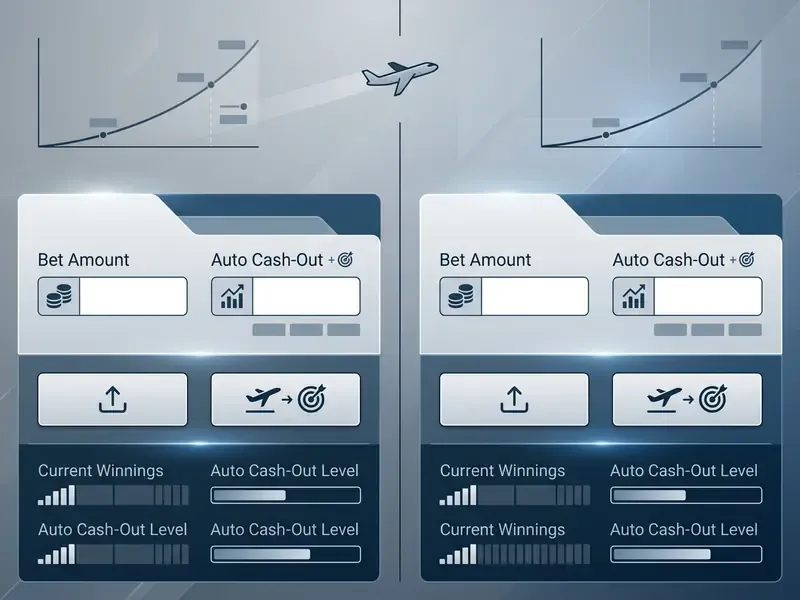
The real decision is balancing risk against payout timing. Each round carries a fixed negative expected value tied to the game's official Return to Player rate, normally 97%, a structural property of crash titles documented in peer-reviewed analysis of return-to-player percentages (Scott, Sher & Daigle, Journal of Gambling Studies, 2026, online-first, https://doi.org/10.1007/s10899-026). Because the crash point is precomputed per round from server and client seeds, waiting for higher multipliers raises the chance of losing the stake at an accelerating rate.
Behavioural evidence on the cash-out button:
«The presence of a cash-out option increased average bet size by roughly 35% in a within-subjects design, with no improvement in win probability.» Bennett et al., People Place Larger Bets When Risky Choices Provide a Postbet Option to Cash Out, Psychological Science (2024). https://doi.org/10.1177/09567976241

Put plainly: the feature that makes Aviator feel controllable is the same feature that statistically inflates exposure. The perceived escape hatch does not change the arithmetic of the round. It changes the size of the number you are risking inside it.
Instruction: how to verify a round yourself through Provably Fair
- Open the round history panel in the top menu of the Aviator client.
- Copy the Server Seed and the three Client Seeds attached to that specific round.
- Paste the combined values into any open SHA-256 hash generator.
- Compare the generated hash with the round hash shown in the game. A full match confirms the operator did not interfere with the result.
Takes about a minute. Worth doing once, if only to stop wondering.

How Aviator Differs from Other Crash Games
The aviator game stands apart from classic slots and from rival crash titles such as JetX or Spaceman through its lightweight interface, live chat, and public bet feed. Standard online slots rely on fixed paylines and reels. Aviator play is built on real-time judgement, and you can watch hundreds of other participants cashing out during the very same flight.
From an engineering angle, spribe built Aviator on HTML5, which keeps it usable on lower-bandwidth mobile networks. For sports media readers and online users across Bangladesh, that matters more than any visual polish. The live stats strip showing recent multipliers adds a sense of transparency, although past coefficients have exactly zero mathematical influence on the next flight. This independence between rounds is not a marketing claim; it follows from the pre-commitment hash model and from the fixed negative expected value described in the Journal of Gambling Studies analysis cited above.
The wider crash-game landscape. The market now offers a broad spread of alternatives built on comparable Provably Fair mechanics:
- JetX (SmartSoft) and Spaceman (Pragmatic Play), classic analogues with configurable auto-cash-out.
- Aviatrix, which supports NFT-avatar integration and aircraft customisation.
- Astronaut, CricketX, Balloon, Avia Masters, Chicken Train, PlinkoX, thematic variations with different volatility profiles and presentation.
- Lucky Jet, a stylistic sibling with the same single-decision cash-out loop.
Most of these titles also ship a free-play mode, which makes them handy for comparing interface latency before you commit real funds. None of them changes the underlying structure: one random terminal event per round, one decision, one fixed operator margin.
Aviator Demo vs Real Money Play: What's the Difference
In two sentences: The demo mirrors the real game mathematically but strips out financial consequence. That asymmetry is exactly why demo confidence transfers poorly to funded play.
The aviator demo lets users test the game with virtual credits and no financial commitment, while aviator real money play involves actual deposits, real balance swings, and access to promotions. Regulated software standards require that official aviator free practice modes use the same Random Number Generator, the same RTP, and the same crash probability distribution as the currency version.
«Free-to-play versions must use the same RNG and prize distribution as the equivalent real-money game.» UK Gambling Commission, Remote Gambling and Software Technical Standards (RTS 6A), current edition. https://www.gamblingcommission.gov.uk/licensees-and-businesses/guide/remote-gambling-and-software-technical-standards
E-E-A-T fact check: Verification of demo conditions confirms that reputable casino platforms serve identical RNG curves in aviator demo mode, yet third-party practice apps and unverified operator mirrors sometimes display altered volatility. Check that the demo client is served from the official spribe cluster before you draw any conclusion about how the game behaves.
| Feature / Parameter | Aviator Demo (Free Play) | Aviator Real Money Mode |
|---|---|---|
| Primary objective | Mechanics learning, UI testing, feature exploration | Currency wagering, real balance risk and rewards |
| Financial stake | Virtual demo credits (zero risk) | Real currency deposit, active bankroll |
| RNG and payout distribution | Identical math model (in regulated software) | Identical math model (97% standard RTP) |
| Live chat and social features | Read-only or simulated interaction | Full community chat and live bets feed |
| Verification and registration | Available on official media sites without deposit | Account creation, KYC and age verification required |
| Psychological friction | Low emotional pressure, no loss risk | High emotional pressure, real loss potential |
| Bonus eligibility | None, demo turnover never clears wagering | Deposit bonuses apply, subject to game weighting |
When moving from aviator free testing into live mode, expect a behavioural shift the moment real funds are at stake. Large-scale epidemiological data quantify the link between the two:
«54% of monetary gamblers had also engaged in simulated gambling; problem gambling was recorded in 33% of that group versus 7% among monetary-only players.» Fiedler, Ante, Meduna et al., Simulated Gambling: An Explorative Study Based on a Representative Survey, Journal of Gambling Studies (2024). https://doi.org/10.1007/s10899-024
So aviator online testing belongs in the category of orientation, not forecasting. The demo teaches you where the buttons sit and how the auto-cash-out slider responds. It cannot teach you how you will behave when the number on screen is your own salary.
Aviator Mobile and Download: Ways to Play from a Phone
In two sentences: Aviator runs fully inside a mobile browser thanks to its HTML5 build, so an installed app is optional. Sideloaded APK files from unofficial channels remain the single largest avoidable security risk in this category.
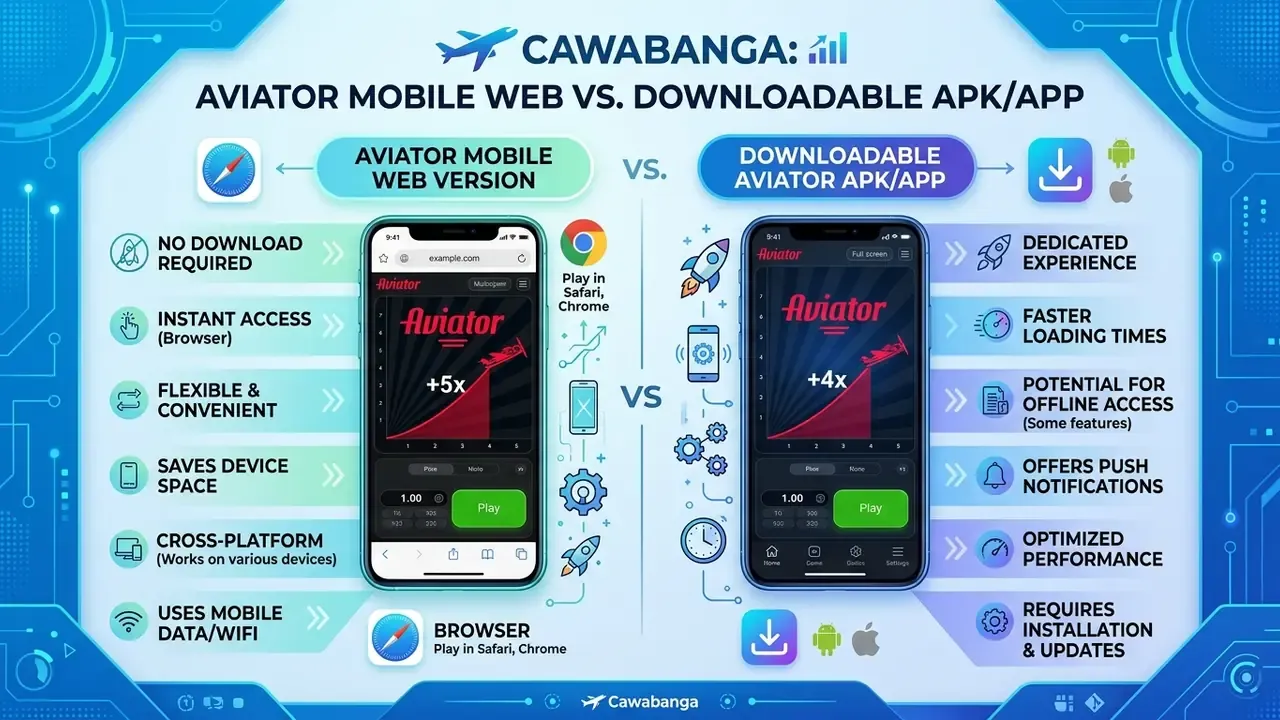
Accessing aviator mobile gameplay happens mainly through responsive browsers or a dedicated operator app, depending on device and store policy. Modern HTML5 architecture allows aviator online clients to run straight inside mobile Chrome, Safari, or Firefox with nothing installed.
«Simulated gambling on mobile devices occupied on average 30.5 minutes per day in the studied sample, compared with 9.4 minutes for monetary gambling.» Russell et al., mobile gambling research (2024). https://doi.org/10.1007/s10899-russell
That gap deserves attention. Mobile demo sessions are consumed in far longer stretches than funded ones, which is precisely how "harmless practice" turns into a daily habit loop.
When You Need an Aviator Download and When the Site Is Enough
A dedicated aviator download, whether an Android APK or an iOS package, is genuinely useful only if you want push notifications for sports events or persistent biometric login. In most cases, reaching the official site through a smartphone browser takes zero storage and guarantees you are on the newest client build released by spribe.
| Operating mode | Technical requirements | Key advantages | Security and operational risks |
|---|---|---|---|
| Mobile browser (web) | Any modern HTML5 browser plus active data | Zero installation, no storage used, automatic client updates | Manual navigation and login entry each session |
| Downloaded app (APK/iOS) | Android 8.0+ or iOS 12.0+, local storage | Biometric login, push updates, faster interface loading | Fake APKs distributed by unauthorised third parties |
Security warning: If you are hunting for an aviator download, don't take APK files from messaging channels or file-sharing mirrors. Unverified executables carry serious malware risk. Use licensed web portals or verified store links only. Android sideloading bypasses store-level review completely, so permission requests and embedded code are never independently inspected.

Mobile Network Behaviour: Bandwidth, Battery, and Dropped Connections
Because Aviator streams a light vector animation rather than video, data use stays modest, usually a few megabytes per hour, which keeps it viable on the constrained 3G and 4G connections common outside major urban centres. The practical bottleneck is not bandwidth but latency. A spike of 800 to 1,200 ms between your tap and the server timestamp can cost you the coefficient you saw on screen.
Three field-tested mitigations:
- Pre-set auto-cash-out instead of tapping manually. These instructions are registered server-side, so they execute at the configured coefficient even if your handset stalls.
- Avoid playing during device updates or on congested public Wi-Fi. Packet loss mid-ascent is the most common cause of "I clicked but it didn't register" complaints.
- Keep battery-saver modes off during a session. Aggressive throttling slows the render loop and desynchronises the visual multiplier from the server value.
Note on exact data figures: consumption varies by operator client build and animation quality settings, so treat the estimate above as indicative and check your own device statistics.
Regulatory and Payment Context for Players in Bangladesh
In two sentences: Bangladesh's gambling framework rests on colonial-era legislation written long before the internet, which leaves online play legally unsettled. Payment routing and data exposure are therefore practical risks, not abstractions.
Legal disclaimer: This section is general educational information, not legal advice, and not encouragement to breach any local law. Gambling legislation in Bangladesh is open to interpretation and subject to change. Consult a qualified local lawyer before acting, and comply with the rules of your jurisdiction.
Legal status. The principal domestic instrument governing gambling in Bangladesh remains the Public Gambling Act of 1867, supported by later provisions prohibiting the operation of gaming houses. That legislation predates remote wagering by more than a century and does not explicitly address offshore online platforms, which produces ambiguity rather than permission. Regulators and telecom authorities have periodically restricted access to gambling-related domains, so ISP-level blocking and sudden loss of site access are realistic operational risks for any user.
Payment risks to weigh before depositing. Mobile financial services such as bKash, Nagad, and Rocket dominate everyday transfers, and many offshore operators accept them indirectly through agents or payment intermediaries. The structural danger sits inside that intermediation:
- Agent-routed deposits may pass through personal wallets rather than corporate merchant accounts, leaving you without a verifiable transaction trail if money disappears.
- Currency conversion into or out of BDT can hide spreads. Confirm whether the operator holds balances in BDT or converts on every transaction.
- Card and bank-account exposure. Using a primary salary account or personal card for gambling-related transfers can trigger compliance reviews or freezes.
- Cryptocurrency rails remove agents but add volatility, wallet-security responsibility, and their own local regulatory questions.
- Data protection. Verify TLS encryption, and never send scans of national ID documents through unsecured messaging apps.
Editorial position: a platform that cannot show a licence registry entry, name its corporate payment processor, and state withdrawal timelines in writing should be treated as unverified, no matter how generous the bonus looks.

Where Aviator Is Available Online and How to Evaluate a Casino Offer
In two sentences: Licence validity and wagering weighting matter far more than headline bonus size. A 500% bonus that excludes crash games from turnover is worth less than a modest offer counting Aviator at 100%.
Finding a licensed site for aviator online means checking operator legitimacy, regulatory status, payment security, and readable promotional terms. Before you register or make a deposit, inspect whether the aviator casino holds an active licence (Curacao, MGA, or a local regulatory clearance) and publishes its wagering conditions openly. Our editorial team keeps ongoing coverage of licensed casino platforms and their compliance documentation.
Comparative Criteria for Evaluating Aviator Casino Offers
When picking a platform for Aviator, the decisive variables are not the size of the welcome package. They are the wagering multiplier and the game weighting applied to crash titles.
| Evaluation parameter | Optimal benchmark | What to inspect closely |
|---|---|---|
| Wagering requirement | Up to 35x-40x | Confirm Aviator turnover counts at 100%. Many operators credit crash games at 5-10%, or exclude them outright. |
| House edge / RTP | 3.00% edge, 97% RTP | The official Spribe client fixes RTP at 97%. Any deviation signals modified or unlicensed software. |
| Payout speed | Instant to 2 hours | Look for automated withdrawals to e-wallets or crypto wallets without hidden fees. |
| Stake limits | From $0.10 to $100 | Micro-stakes are mandatory for correct bankroll management on small balances. |
| Licence transparency | Clickable registry entry in footer | A licence logo that is an image rather than a verifiable link is a red flag. |
| Local payment support | BDT balances, verified mobile financial services | Prefer corporate processors over individual agent wallets. |
| Provably Fair access | Verification tool inside the game UI | You should be able to reproduce a round hash without contacting support. |
| Responsible gaming tools | Deposit, loss, and session limits | Limits must be configurable before the first deposit, not after. |
[❓ QUIZ (optional interactive module): 4 questions to assess casino-offer reliability before the first bet. Results grouped into 3 risk levels.] Purpose: Help the reader structure their assessment of licence, limits, and bonus wagering. Semantics: section with form role, aria-labels, results rendered as a definition list.
Which Casino Terms Matter Before Your First Bet
Before funding an account on any site, read the offer rules and the game restrictions attached to bonus funds. Plenty of platforms exclude crash games from contributing 100% toward wagering, which means a stated 30x rollover can behave like something far steeper when you are playing aviator.
Key metrics to inspect prior to wagering:
- Minimum and maximum stake limits. Check that the betting panel allows micro-stakes suited to conservative bankroll management.
- Bonus wagering eligibility. Verify whether aviator game turnover counts fully toward clearing deposit bonus funds.
- Withdrawal terms and verification. Confirm KYC requirements are spelled out before you deposit, not discovered at cash-out.
- Responsible gaming controls. Make sure the casino offers instant deposit limits, cool-off periods, and self-exclusion.
- Max-bet clauses while a bonus is active. Many offers cap the permitted stake near 2% of the deposit, and breaching it can void winnings retroactively.
«Continuous games with high event frequency and rapid outcomes rank among the riskiest gambling formats in research classifications.» Gooding & Williams, Are there riskier types of gambling? (2024). https://doi.org/10.1007/s10899-024-gooding
That classification lands squarely on Aviator: rounds resolve every 8 to 10 seconds, compressing the interval between a loss and the next chance to stake down to almost nothing.
How to Start Playing Aviator Step by Step
To explore aviator play safely, follow a compliance-first sequence that puts account security and spending control ahead of speed:
- Select an evaluated media or review portal. Use an established information hub such as the iGaming Bangladesh analytical portal to inspect platform credentials before registering anywhere.
- Test the aviator demo. Launch the aviator demo and get familiar with double bets, auto-cash-out sliders, and interface response times.
- Complete account registration. Create an account on the licensed site, using accurate legal details for later identity verification.
- Configure responsible gambling limits. Before your first deposit, set daily or weekly loss caps in account settings.
- Verify the payment route. Confirm the deposit is handled by a corporate processor and that withdrawal uses the same channel.
- Launch the game. Open the instant games section, find the official Aviator title by Spribe, and set your starting stake.
For regional coverage and compliance breakdowns on sports media and gaming industry standards, readers can consult the iGaming Bangladesh Analytical Portal, which publishes educational material on regulatory frameworks, local payment security, and responsible media practice.
Checklist: evaluating a casino offer for Aviator
- Licensing verified through the registry entry in the operator footer
- RTP and Spribe vendor origin confirmed inside the game client
- Bonus terms explicitly cover crash games and Aviator weighting
- Deposit and loss limits configured in the account profile
- Mobile browser interface tested and running without lag
- Withdrawal method and processing timeline stated in writing

Aviator Strategy: Stake Management and Working with Multipliers
In two sentences: No system alters the fixed house edge, so "strategy" in Aviator means variance control, not prediction. The models below reduce how fast a bankroll can be destroyed, nothing more.
A structured aviator strategy is about bankroll discipline, risk distribution, and automated cash-out execution. It is not about predicting random outcomes. Because the game runs on a verified Random Number Generator, no prediction software, Telegram signal, or betting sequence changes the house edge. The expected value of each round stays fixed and negative regardless of staking pattern, as established in the crash-game expected-value analysis published in the Journal of Gambling Studies (Scott, Sher & Daigle, 2026, online-first, https://doi.org/10.1007/s10899-026).
[💬 QUOTE: "In continuous crash games, mathematical expectation remains fixed regardless of pattern history. Managing stake distribution is a risk-reduction tool, not a method for guaranteeing returns." Sports Analytics Editorial Team]
Purpose: E-E-A-T reinforcement of the risk-management concept.
Semantics: blockquote with cite.
Disclaimer: This information is general in nature and does not replace professional advice. Aviator is a real-money game with negative mathematical expectation. No strategy guarantees a positive financial result.
Multiplier Probability Distribution and Three Bankroll Models
Honest risk assessment starts with the probability distribution implied by the Provably Fair algorithm, not with anecdotes from chat. Based on analysis of open server-hash logs and the published 97% RTP model:
- 1.30x-1.50x:reached in roughly 70% of rounds. The most stable band for systematic cash-out.
- 2.00x:survival probability of about 48.5% (1 ÷ 2.00 × 0.97), which is simply the 3% edge showing up.
- 10.00x and above:fewer than 9% of rounds. Treat it as a high-variance anomaly, not a target.
The arithmetic generalises neatly: survival probability to any coefficient k approximates 0.97 ÷ k. That one formula dismantles most "guaranteed system" marketing, because it shows the edge stays constant across every coefficient you might pick.
1. Automatic cash-out at 1.50x (fixed-risk model)
- Mechanics:set the auto-cash-out field to 1.50x and stop intervening manually.
- Bankroll math:split the bankroll into 50 units, so a $100 bankroll means a $2 stake. Each successful iteration returns 50% of the stake. At roughly 70% hit frequency, the model absorbs local losing clusters over a horizon of 30 or more rounds, while still trending toward the house edge across very long samples.
- Why it helps:it removes reaction time and the "just one more second" impulse from the equation.
2. Paired insurance model (split bet)

- Mechanics:uses the dual-bet panel.
- Bet A (core):70% of the round's total stake, auto-cash-out at 1.30x, designed to offset the likely loss of the second bet.
- Bet B (risk):30% of the total stake, cashed out manually between 2.00x and 3.00x.
- When it fails:during clusters of 1.00x-1.20x crashes both bets burn, and the model collapses entirely if the player quietly enlarges the risk portion after a loss.
3. Low-amplitude "fence" model
- Mechanics:a fixed micro-stake, no more than 1-2% of the deposit, with fast auto-cash-out at 1.15x-1.20x.
- Purpose:minimise volatility while clearing bonus turnover or stress-testing an unfamiliar interface on a live balance.
- Limitation:one missed round erases several successful ones, so an absolute session stop-loss is non-negotiable.
Universal bankroll rules that outrank all three models: define the bankroll before you open the game; never stake more than 5% of it in one round; cap session losses at 30-40% of the bankroll; stop after a predetermined number of rounds even while winning; and never raise stakes after a loss, because chasing can double a deficit in a single click.
Why Stake Size Matters More Than Chasing High Multipliers
Strict stake control matters far more than a big multiplier, because high coefficients arrive with exponentially lower probability. Controlled behavioural trials (Bennett et al., 2024, Psychological Science, https://doi.org/10.1177/09567976241) found that an in-game cash-out feature pushes players toward noticeably larger initial bets, under the comfortable illusion that they can always slip out before the crash.
«In a naturalistic experiment with 377 online bettors, the cash-out option increased stake size and interface engagement time without changing odds selection.» Sciety Discovery preprint extending Bennett et al. (2024-2025). https://sciety.org
Mathematically, aiming at a 100x coefficient in aviator real money mode produces long strings of losses that drain an unmanaged bankroll quickly. A balanced approach keeps stake sizes small, around 1-2% of the available balance per round, and uses automated cash-out targets between 1.30x and 2.00x to remove emotional delay from the loop.
There is also a compounding argument beginners routinely underestimate. A 50% drawdown demands a 100% gain to recover. Since outcomes multiply rather than add, avoiding deep losses does more for long-run bankroll survival than occasionally catching a rare tail event. That is the unglamorous part of the maths, and it is the part that decides who is still playing next month.
Common Mistakes Players Make When Playing Aviator
When playing aviator, inexperienced users fall into a predictable set of behavioural traps that speed up bankroll depletion. Recognising them is the first step toward staying in control:
- Chasing losses (Martingale staking). Doubling the bet after a loss on the false belief that a high multiplier "is due".
- Trusting signal bots. Relying on fraudulent Telegram or WhatsApp "predictor" tools that claim to forecast the exact plane crash timing. Because the crash point is committed cryptographically before betting opens, such forecasting is computationally impossible. These tools exist to harvest deposits and referral commissions.
- Neglecting auto-cashout tools. Trying to hit the button by hand during high-volatility spikes instead of using pre-set triggers.
- Overestimating demo proficiency. Assuming a strong session in aviator free mode predicts the same result on a funded balance.
«Participation in simulated gambling predicted monetary gambling frequency across all formats except simulated lotteries, after controlling for demographic variables.» Hing et al., The convergence of simulated gambling, monetary gambling…, New Zealand Ministry of Health (2025). https://www.health.govt.nz
- Ignoring limits at micro-stakes. Low minimum bets feel harmless, and that is the trap: the lower the stake, the stronger the urge to repeat it, so total exposure grows through frequency rather than size.
- Treating a losing streak as an algorithm error. Seven consecutive 1.10x crashes is a statistically normal event, exactly as a 10x cluster is. Neither proves manipulation, and neither predicts the next round.
⚠️ ALERT: financial risk and RNG transparency Aviator is a game of chance. No mathematical strategy, betting algorithm, or prediction signal guarantees positive financial outcomes or bypasses the Provably Fair RNG model. All aviator real money wagering carries financial risk, and no one should stake funds they cannot afford to lose in full.
Responsible Gambling and Aviator Accessibility
Disclaimer: This information is general and does not replace consultation with a problem-gambling specialist. If you notice signs of dependency, contact a psychological support helpline in your region.
Responsible gambling practice becomes essential with high-velocity continuous games like Aviator. Rounds resolve in seconds, so emotional discipline, scheduled time-outs, and strict adherence to pre-set loss caps do the heavy lifting for user safety and financial well-being.
1. Set mandatory deposit and loss caps. Before launching Aviator, define an absolute session loss limit inside account controls. Once that figure is reached, close the client immediately, whatever the last few rounds looked like.
«Crash games combine five structural risk factors: high speed, a cash-out button, illusion of control, near-miss effects, and frictionless loss-chasing.» CrashEdge, synthesis of crash-game literature (2026). https://crashedge.com

Regulatory frameworks respond to precisely those factors. Under the UK Gambling Commission's Licence Conditions and Codes of Practice, operators must provide deposit limits, loss limits, session-time reminders, and self-exclusion. If a platform lacks any of them, read that as information about the platform, not about your own willpower.
2. Restrict session duration and take regular breaks. The pace of crash games distorts time perception. Cap continuous play at 15 to 20 minutes and use built-in reminders or a phone alarm to step away and reassess.
3. Never treat gambling as a source of income. Aviator is an entertainment product with a built-in operator margin. It is not an investment, a debt-recovery tool, or an earning scheme.
4. Recognise impulsive chasing and use self-exclusion. If you feel the urge to deposit immediately after a losing round, pause instantly. Licensed platforms provide 24-hour panic buttons and long-term self-exclusion registries for exactly this moment.

Crash-Game Psychophysiology: The "Lost Profit Effect" and Tilt Control
Aviator's tempo, a fresh round every 8 to 10 seconds, produces a repeating dopamine response driven by upward motion, a rising number, and a countdown. The loop keeps working even when you are not betting, because watching alone sustains arousal.
When a player sees the coefficient climb to 15x or 20x moments after banking a modest 1.30x, the lost profit effect kicks in: forgone profit gets processed emotionally as a real loss. The next stake goes up, and it goes up for the wrong reason, not because odds were calculated but because nobody wants to "miss out" twice. This is the retention core of the format. Aviator doesn't ask you to analyse; it asks you to react. The longer a session runs, the weaker analysis becomes against impulse.
The disciplinary pause rule. To break the impulse cycle and restore deliberate calculation, take a mandatory two to three minute break after every four rounds played, regardless of result. Empirically, a structured pause beats most staking "systems" circulating on video platforms, because it lets you see the situation from outside the tension instead of from inside it.
Immediate red flags requiring a hard stop: thinking "it definitely has to fly long now"; recalculating losses in terms of the single 10x that would recover them; depositing within minutes of a losing streak; hiding session length or spend from people close to you; or touching funds allocated to rent, tuition, or credit repayment. In any of those cases, end the session, activate a cool-off period, and if the pattern repeats, use self-exclusion and contact a qualified support service.
FAQ: Technical Failures, Connection Drops, and Round Verification
The round resolves on the operator's server, not on your device. If you configured an auto-cash-out value, the instruction executes at that coefficient even while your handset is offline. If you placed a manual bet with no auto-cash-out and the connection fails, the bet stays active until the crash, and it is lost. Practical rule: never place a manual-only bet on an unstable connection.
Not during latency spikes. The animation is a render of server state, so delayed packets can leave the displayed number trailing the authoritative one. Another argument for pre-set triggers over reflex tapping.
Yes. Open round history, extract the server seed and client seeds, hash them with any public SHA-256 tool, then compare to the committed hash shown in the client. A match confirms the outcome was fixed before betting opened.
No. Rounds are independent, and Aviator does not store or analyse an individual player's betting history. The game neither takes revenge for wins nor wins back losses. Those beliefs are stories built after the fact, usually after a bad sequence.
In licensed software, no. RTS 6A-aligned standards require identical RNG and prize distribution. The difference is emotional load, and that difference is large enough to change how you play.
It depends entirely on game weighting. Some operators count crash games at 100%, others at 5-10%, and some exclude them. Read the bonus terms before depositing, not after.
Only a few megabytes per hour in typical conditions, because the game is a light HTML5 build rather than a video stream. Exact figures vary by client build, so check your device's data statistics.

Key Takeaways and Editorial Summary
- Understand the mechanics. The aviator game by Spribe runs on a Provably Fair RNG where the coefficient rises from 1.00x until an unpredictable crash, with survival probability approximating 0.97 ÷ target coefficient.
- Use the demo safely. Test the aviator demo to learn the dual-bet panel without financial risk, but never mistake demo success for a predictive edge.
- Evaluate operator offers properly. Choose licensed portals with transparent bonus terms, wagering at 35x-40x or lower, confirmed 100% crash-game weighting, clear deposit conditions, and accessible responsible gaming tools.
- Prioritise bankroll control over multipliers. Stick to disciplined stake management: 1-2% per round, a 50-unit allocation, and a hard session stop-loss, rather than chasing rare high-coefficient flights.
- Control the psychology. Recognise the lost-profit effect and enforce a pause every four rounds to block impulse-driven stake escalation.
- Respect local context. In Bangladesh, assess legal exposure, payment routing, and data handling before depositing, and prefer corporate processors over agent wallets.
- Practise responsible gaming. Keep strict financial limits, respect 18+ compliance, and follow regional legal standards before any online wagering. Gambling is entertainment with a built-in operator margin. It is never an income strategy.