Mines Casino Game Rules, RTP, Providers

Mines Casino Game: Rules, RTP, Providers, Mobile Apps And Realistic Strategy

Last updated: February 2026 · Reviewed by: the editorial iGaming desk · Audience: 18+ (or the legal gambling age in your jurisdiction)

Quick summary. Mines is a minesweeper-style casino "Originals" game. You set a stake, choose how many mines are hidden on a grid (usually 5×5 = 25 cells), open safe tiles one by one while the multiplier grows, and cash out before you hit a bomb. Published provider RTPs cluster between 95% and 99%, every round is independent, and no "pattern", bot or signal service can beat a negative expected value. This guide covers the mathematics, the correct way to install mobile versions (and why the real-money app is not in Google Play or the App Store), three realistic bankroll templates, a licence-verification checklist and a fact-check of the most common myths.

Key numbers before you read further

  • 25 cells on the standard board, 1 to 24 selectable mines.
  • 96% chance of surviving a single reveal on a one-mine board, roughly 0.09% of surviving ten reveals on a ten-mine board.
  • 3% of turnover is the designed cost of play at 97% RTP, not 3% of your deposit.
  • 0% wagering contribution at many operators, which quietly cancels most "bonus farming" plans.

One more framing note, because it matters for readers in Bangladesh and other markets without a domestic licensing regime. We write about Mines the way we would write about a fixture list: mechanics, numbers, risks, and what the rules actually say. No promises, no "guaranteed" systems. If a page tells you a grid game can be beaten, that page is selling something.

1. What Mines Is And Where It Came From

In two sentences: Mines takes the grid of the classic Minesweeper puzzle and replaces logic with wagering, so each reveal is a bet rather than a deduction. The format is distributed by several studios (Spribe, Hacksaw Gaming, Turbo Games, Jili Games and in-house "Originals" teams such as Stake), each with its own grid sizes, mine limits and published return to player.

1.1. Mines As A Modern Casino "Originals" Game

Mines belongs to the same family as crash, dice and plinko: minimal interface, sub-ten-second rounds, no reels or paylines, and cash-out multipliers that grow as players safely reveal tiles before hitting a bomb.

Here is the crucial difference from the Windows puzzle. In a real minesweeper game, numbers on opened squares tell you where the danger sits, so skill compounds. In the casino version there are no clues at all. Every click is a fresh coin flip weighted by the remaining cells. Same visual grammar, completely different game.

«Analysis of crash games shows that most players cash out at modest multipliers, despite mathematically possible hundreds of times their stake.» Source: Scott et al., UNLV Gaming Research & Review Journal (2023-2025). https://digitalscholarship.unlv.edu/grrj/

That behavioural pattern matters for Mines

That behavioural pattern matters for Mines, because the game is built on exactly the same tension: the multiplier is always visible, always climbing, and the decision to stop is always yours. The interface gives an unusually strong feeling of control (you choose the cells, you choose the moment) while the underlying outcome is fixed by a random mine layout before your first click.

Two design features explain the format's speed of adoption. First, the nostalgia hook: virtually everyone who has used a Windows PC recognises the grid. Second, configurability. The player, not the studio, sets the risk level by choosing the number of mines, which is rare in slots and closer in feel to a table game.

1.2. Search Strategy And Evidence Limitations

1.2. Search Strategy And Evidence Limitations

For this guide we separated three tiers of evidence: (a) official provider and operator documentation for game parameters; (b) peer-reviewed behavioural research for anything about player decisions and risk; and (c) affiliate or industry articles, which we treat as unverified and quote only with an explicit caveat.

Peer-reviewed literature on Mines specifically is effectively non-existent. The closest usable evidence base is research on crash games (structurally the same escalating-multiplier, manual-cash-out mechanic), research on electronic gaming machines and losses disguised as wins, and a 2025 experimental study on RTP and house edge messaging in slots, published in Addictive Behaviors.

«A study of 6,062 players found that a 90% RTP message increased optimism about winning more than fivefold compared with receiving no information.» Source: "Never tell me the odds", Addictive Behaviors (2025). https://www.sciencedirect.com/journal/addictive-behaviors

Where a number circulates widely online but has no dataset behind it, we say so rather than repeating it as fact. Every claim in Appendix A falls into that category.

2. How Mines Works

In two sentences: The standard board is 25 cells with a player-selected number of mines placed at random before the round begins; each safe reveal raises the multiplier and each mine ends the round with the loss of the stake. Demo mode reproduces the mechanics and the RTP model but not the financial consequences, which is precisely why it is a poor predictor of how real-money sessions feel.

2.1. Game Field, Safe Cells, And

2.1. Game Field, Safe Cells, And Hidden Mines

The default field is a 5×5 grid containing 25 positions. Before your first click, the engine distributes the chosen number of mines randomly across those cells; the layout is then fixed for the round. Your clicks do not "move" mines, and the engine does not decide where a mine is at the moment you click. The result of each move is determined by an already-committed layout.

The multiplier is recalculated after every safe reveal. It rises because the pool of remaining safe cells shrinks while the mine count stays constant: with 5 mines and 20 safe cells, your first pick is safe with probability 20/25 = 80%, the second 19/24 ≈ 79%, and so on.

Clearing all safe cells at high mine counts produces enormous coefficients, and correspondingly tiny probabilities.

Updated (verified formulation). Industry articles frequently state that a configuration with 5 mines and 20 safe openings yields an average cash-out multiplier of around 1.35×. We could not verify this figure against any dataset or provider document, so we treat it as an unsourced illustration rather than a parameter (see Appendix A). What is mathematically defined is the relationship itself: more mines mean faster multiplier growth per reveal and a steeper drop in the probability of surviving each additional click.

«Crash games demonstrate that rare large wins do not change a negative expected value; it is determined by the entire distribution of outcomes.» Source: Scott et al., UNLV Gaming Research & Review Journal. https://digitalscholarship.unlv.edu/grrj/

2.2. Demo Mode Versus Real-Money Play

2.2. Demo Mode Versus Real-Money Play

Mines demo (free-play) runs the same grid logic and the same multiplier table as the paid version at most licensed operators, so it is genuinely useful for learning the interface, testing mine counts and seeing how quickly coefficients scale. Free rounds are unlimited, no download is required, and nothing is at stake. What demo cannot reproduce is loss aversion, chasing, or the temptation to raise a stake after a bad streak.

There is a second, less obvious asymmetry: demo play is usually desktop or mobile-browser based and frictionless, while playing Mines for real money increasingly happens on a phone, in private, with promotions one tap away.

«Factor analysis of betting sessions identified five situational dimensions; three of them, mobility, privacy and promotional access, were significantly associated with short-term harm.» Source: study of situational factors in smartphone betting (2023).

In the same literature, greater short-term

In the same literature, greater short-term betting harm was significantly associated with sessions where the ability to bet anywhere anytime, privacy, and greater access to promotions and options were prioritised. Translated to Mines: a five-minute demo session on a laptop and a five-minute real-money session on a phone at midnight are not the same activity, even though the maths is identical.

Practical note: if your operator credits demo balance in the tens of thousands, reset it to a figure that matches your real bankroll before testing a strategy. Testing a Martingale ladder with a fake 100,000-unit balance teaches nothing about a real 5,000-unit one. I have seen readers "prove" a system on 50,000 play chips and lose the plot in nine real rounds.

Disclaimer. This information is general in nature and does not replace professional advice. Real-money play carries financial risk; if you notice signs of problem gambling, consult a specialist or a national helpline.

2.3. Providers, Grids And RTP: Comparison Table

Mines is released by several studios, each embedding its own return-to-player and field parameters. Verify the RTP shown inside the game's own info panel at your operator, because operators occasionally licence lower-RTP configurations.

Provider / versionGridMinesPublished RTPMax winNotes
Spribe Mines5×5 (25 cells)1-24Not published in Spribe's official materials; operators commonly display ~97%Depends on mine countThe most widely distributed international version. https://spribe.co
Hacksaw Gaming Mines3×3, 5×5, 7×7, 9×91-8898%, stated as tested over 10,000,000,000 simulated roundsup to ×10,000Most flexible risk configuration; released 2022. https://www.hacksawgaming.com
Stake Originals Mines5×5 (25 cells)1-24~99% (house edge ≈1%)Depends on configurationProvably fair; exclusive to Stake platforms. https://stake.com
Jili Games Mines5×51-2497%up to ×10,000Popular in Asian-facing casino lobbies
Turbo Games Mines5×5player-selected95% (explicitly stated on the official product page)Depends on configurationThe only version in our source set with a formally published numeric RTP. https://turbogames.io

Fact-check. A widely copied strategy article claims the Stake Mines settings menu offers a 12×12 minefield. That is wrong: Stake Originals Mines uses a standard 5×5 grid of 25 cells with 1 to 24 mines. Only Hacksaw's version offers alternative grid sizes (3×3, 5×5, 7×7, 9×9). Larger grids pay less per gem but reduce the per-click chance of hitting a mine.

3. Playing A Round Step By Step

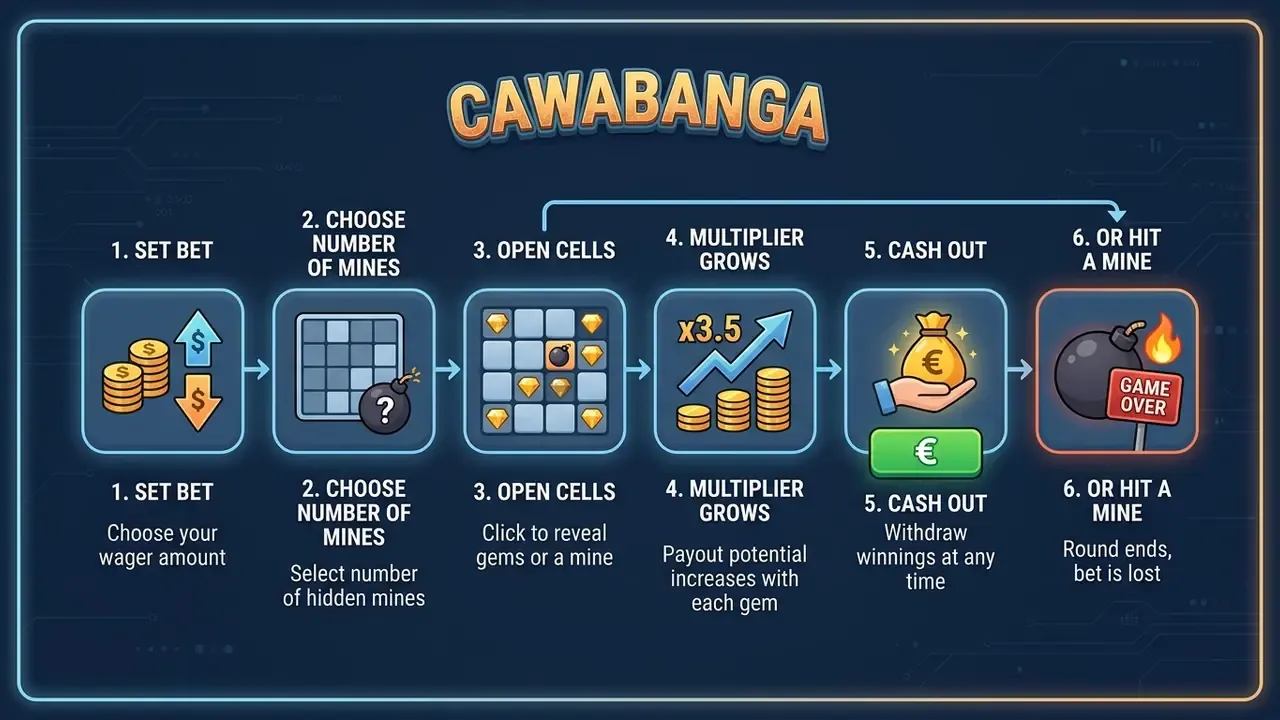
In two sentences: A round is six decisions long: stake, mine count, open, watch the multiplier, continue or stop, cash out. Everything that determines your long-run result happens in the first two steps and the fifth.

3.1. Choosing Stake Size And Number Of Mines

Stake size controls exposure; the number of mines controls volatility. A 1-mine board with a single reveal wins about 96% of the time and pays roughly 1.01-1.03× depending on the version. A 20-mine board with three reveals pays in the hundreds and wins roughly 0.2% of the time. Both configurations sit on the same RTP curve: expected value remains below one because of the house edge embedded in the multipliers.

«In crash games, theoretical bet values calculated from real operator data confirm that expected value stays negative at any cash-out multiplier.» Source: Scott et al., UNLV Gaming Research & Review Journal. https://digitalscholarship.unlv.edu/grrj/

Practical sizing rules that experienced players in mobile casino games apply to Mines:

Cawabanga heading-banner
  • Unit sizing:0.5-1% of session bankroll per round for low-mine play, 0.1-0.25% for high-mine hunting.
  • Session cap:a hard loss limit set before the first click, plus a win-lock (for example, stop if the balance is +30%).
  • Round cap:decide the number of reveals before the round starts. Deciding mid-round is where discipline dies.
  • Never scale to recover:a doubled stake does not improve the probability of the next reveal; the layout is already fixed.
3.2. Deciding When To Continue And

3.2. Deciding When To Continue And When To Cash Out

There is no mathematically optimal cash-out point that produces profit, because every additional reveal has both a higher multiplier and a lower survival probability, and the product is always shaded by the house edge. What the cash-out button does control is variance: early cash-outs mean many small wins and occasional losses; late cash-outs mean many losses and occasional large wins.

The bigger risk is misperception. In the 2025 experiment, players who received the 90 percent RTP statement reported significantly higher perceived chances of winning than those in the no-information condition, with odds ratios greater than 5.

«Participants shown a 90% RTP message expected to win more than five times as often, even though the game retains 10% of all stakes.» Source: "Never tell me the odds", Addictive Behaviors (2025). https://www.sciencedirect.com/journal/addictive-behaviors

A second distortion is specific to Mines-style games with partial returns: a round cashed out at 1.10× after a 1.00 stake is a win, but a session of such rounds interrupted by one full loss is not. Research on electronic gaming machines shows participants exposed to losses disguised as wins (LDWs) significantly overestimated their net earnings compared with conditions where only genuine wins were celebrated.

«A 2023 experiment showed LDWs unambiguously cause overestimation of net winnings; players systematically counted losing rounds as profitable.» Source: study of losses disguised as wins in electronic gaming machines (2023).

Cash-out heuristics that at least keep you honest: write the target multiplier down before the round; log every round's net result, not the celebratory sound; and treat the balance figure, never the multiplier animation, as the only feedback that counts.

Disclaimer. This information is general in nature and does not replace professional advice on responsible gambling.

3.3. Five-Step Checklist For A First Session

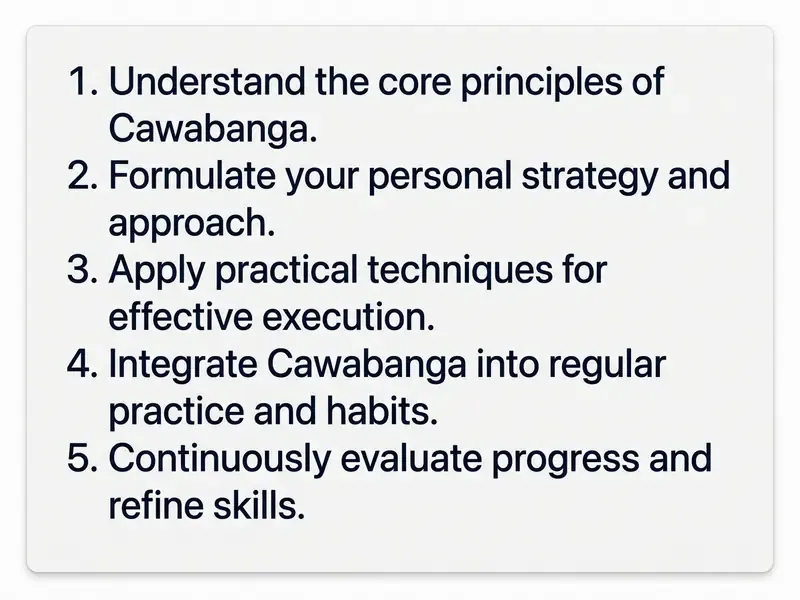
  1. Open the demo version of the exact provider you intend to play and check the RTP in the info panel.
  2. Set the stake to a unit you can lose 40 times in a row without emotion.
  3. Set the number of mines. Start at 1-3 mines while you learn the multiplier ladder.
  4. Open cells to a pre-declared number of reveals, then press Cash Out. Do not improvise.
  5. Withdraw early and verify the payout route: complete KYC before your first deposit, not after your first win.

4. The Mathematics Of Mines

In two sentences: Mines multipliers are a closed-form function of grid size, number of mines and reveals, scaled down by the operator's edge. That scaling factor, not luck, streaks or timing, is the only structural determinant of long-run results.

4.1. Mathematical Structure Of Multipliers And The Role Of Mine Count

For a 25-cell grid with N mines and s successful reveals, the fair (zero-edge) coefficient equals the reciprocal of the survival probability:

Fair multiplier = C(25, s) / C(25 − N, s)

Operators then apply the RTP factor. For a 97% game, the actual cash-out multiplier offered is approximately 0.97 × C(25,s)/C(25−N,s); for a 99% game the factor is 0.99, and for Turbo Games' 95% version it is 0.95.

«Calculation of theoretical values from crash-game operator data confirms that the built-in house advantage persists at every multiplier level.» Source: Scott et al., UNLV Gaming Research & Review Journal. https://digitalscholarship.unlv.edu/grrj/

Illustrative multiplier progression (5×5 grid, 97% RTP factor, rounded):

Mines1 reveal3 reveals5 reveals10 revealsSurvival chance at the last listed reveal
11.01×1.10×1.21×1.62×~60%
31.10×1.45×1.96×4.90×~19.8%
51.21×1.96×3.32×17.16×~5.7%
101.62×4.90×17.16×1,055×~0.09%
204.85×223×51,536× (capped by max win)n/a5 reveals ≈ 0.0019%
Read the table as a risk

Read the table as a risk ladder, not a payout promise: every step to the right multiplies the prize and divides the probability by more than the same factor.

Updated (verified formulation). Third-party articles state that "a twelve-mine setup with 13 safe openings might reach roughly 3.8× with medium-high volatility". Using the formula above, a 12-mine board pays roughly 1.86× after two reveals and roughly 2.53× after three at a 97% factor, so the quoted pairing of "13 safe openings" with "3.8×" is not reproducible. We retain the original wording in Appendix A and treat it as an unverified illustration.

Correction to a popular strategy claim. The frequently repeated line that "two successful reveals on a 10-mine board pay more than ×3.0" is also inaccurate: the correct value is ≈2.77× at 97% RTP and ≈2.83× at 99% RTP.

4.2. RTP Information, House Edge, And Player Perceptions

RTP is a long-run ratio: total returned to players divided by total wagered. At 97%, the expected cost of play is 3% of turnover, not 3% of your deposit, and not a per-round guarantee. That distinction is where most player reasoning collapses.

The 2025 Addictive Behaviors experiment also found that higher scores on the Problem Gambling Severity Index (PGSI) were associated with greater perceived chances of winning, a trend not observed in the RTP or house-edge message groups.

«In the no-information group, a high PGSI score predicted inflated win expectations, an effect that disappeared under any form of RTP message.» Source: "Never tell me the odds", Addictive Behaviors (2025). https://www.sciencedirect.com/journal/addictive-behaviors

This is the strongest available argument that transparency about house edge is a harm-reduction tool, not marketing. Several researchers argue that more explicit house-edge framing, such as stating that "this game is designed to retain 3 percent of all bets", would convey the negative expectation better than a percentage that sounds close to 100.

«Research using an online problem gaming behaviour index found that slots and roulette correlate positively with high PGSI scores among online players.» Source: Online Problem Gaming Behavior Index study.

Because Mines shares the rapid, repetitive, high-frequency structure of those products, the same caution applies. Readers who want the broader industry context, meaning how operators, providers and certification bodies interact, can start with our overview of online gambling and iGaming, which sets out where responsibility for online gambling harm sits in the supply chain.

4.3. Why RTP Does Not Guarantee A Win In Any Individual Round

Expected value describes the mean of a very large sample. A 98% game can take twenty consecutive stakes from you, and a 95% game can pay 1,000× on your first click; neither event says anything about the model. The presence of rare big wins does not change the negative expectation. It simply makes the distribution more volatile.

«Integrating across the whole distribution of crash points shows that the existence of rare 100× and 1,000× wins does not remove the negative expected value of the bet.» Source: Scott et al., UNLV Gaming Research & Review Journal. https://digitalscholarship.unlv.edu/grrj/

There is also a behavioural sting in the tail: RTP messages may encourage longer play and greater exposure to volatility, which in turn increases the risk of large short-term losses.

«It is experimentally confirmed that a 90% RTP message significantly increased player optimism, potentially lengthening sessions and increasing total losses.» Source: "Never tell me the odds", Addictive Behaviors (2025). https://www.sciencedirect.com/journal/addictive-behaviors

Formally, if a single round wins with probability p, the chance of no win across n independent rounds is (1 − p)ⁿ. That value shrinks towards zero but never reaches it, which is exactly why "it's due" is never true.

Fact-check note. All game parameters in this guide were checked against provider product pages and operator info panels in February 2026. Parameters change without notice; re-read the in-game panel before you play, since that panel, and not a review, is the binding source.

5. Strategies: Managing Volatility Versus Chasing Systems

In two sentences: Staking systems redistribute risk across rounds; none of them changes the sign of the expected value. The useful skills in Mines are bankroll discipline, pre-declared exit rules and resistance to pattern narratives.

5.1. Low-Mine, Early Cash-Out Strategies As Volatility Management

A 1-2 mine board with one or two reveals produces frequent, tiny wins. The attraction is smoothness: over many rounds they still tend toward the designed loss rate of approximately 3 percent, but the path there has far fewer cliffs.

«Analysis of crash games confirms that early cash-out strategies reduce variance but do not change the negative expected value built in by the operator.» Source: Scott et al., UNLV Gaming Research & Review Journal. https://digitalscholarship.unlv.edu/grrj/

Fewer mines with an early cash

Fewer mines with an early cash out may produce smoother bankroll trajectories and reduce the likelihood of catastrophic loss in a single round. We flag this as a logically sound but empirically untested claim for Mines specifically: the variance-reduction argument is standard probability theory, and the crash-game literature above supports the analogy, but no published dataset measures Mines bankroll trajectories directly. Treat it as risk shaping, not as an edge.

One genuinely practical use case: low-mine play is the most efficient way to accumulate wagering turnover for a bonus with minimum variance, provided Mines actually contributes to that bonus (see §7).

5.2. Randomness, Pattern-Seeking, And The Ineffectiveness Of "Systems"

Mine layouts are fixed per round by an RNG, or by a provably fair seed pair. Rounds are independent, so no history of "cold corners" or "hot diagonals" carries predictive information. Where independence holds, pattern-hunting is indistinguishable from reading tea leaves.

The illusion is reinforced by partial-return feedback: players overestimate how much they have won, which can reinforce erroneous beliefs that a particular strategy is working even when the balance is falling.

«An LDW experiment showed participants systematically overestimated net winnings, creating the illusion of a working strategy during real losses.» Source: study of losses disguised as wins in electronic gaming machines (2023).

Product type matters too. In population research, slot machines, roulette and horse race betting are positively associated with higher PGSI scores.

«The online problem gaming behaviour index showed that slots and roulette correlate significantly with high PGSI scores, unlike strategic card games.» Source: Online Problem Gaming Behavior Index study.

If you play fast online casino games at all, treat every "predictor", "signal channel" or "Mines hack bot" as fraud by default. Provably fair outcomes are cryptographically committed before your click; no external software can read them, and the tools that claim otherwise exist to harvest deposits and credentials.

Disclaimer. This information is general in nature and does not replace professional advice. No strategy guarantees a win in games with a negative expected value.

5.3. Three Practical Templates With Honest

5.3. Three Practical Templates (With Honest Risk Labels)

1. Minimum-risk "1:1 Ratio", low volatility

  • Setup: exactly 1 mine on a 5×5 grid.
  • Method: open a single cell, cash out immediately, repeat.
  • Per-round win probability: 24/25 = 96%; payout ≈1.01-1.03×.
  • Purpose: turnover accumulation and bonus wagering with minimal drawdown. Note the asymmetry: a single loss erases roughly 33 to 100 winning rounds, so a stop-loss is mandatory.

2. Martingale, high capital requirement, unchanged edge

  • Setup: 3 mines on a 5×5 grid; fix 2-3 cells you open every round (win probability ≈ 65% for two reveals, ≈ 55% for three).
  • Method: double the stake after each loss, return to base after a win.
  • Requirement: bankroll for at least 7-8 consecutive doublings, plus a table maximum that permits them. Eight doublings from one unit costs 255 units to recover one.
  • Reality check: Martingale converts many small wins into one catastrophic loss. D'Alembert (increase by one unit after a loss, decrease by one after a win) softens the ladder but recovers slower; neither system alters the house edge.

3. "More mines" multiplier hunting, high volatility

  • Setup: 10-15 mines, minimum stake.
  • Method: open 2 cells and cash out. At 10 mines, two reveals pay ≈2.8× with a ≈32.5% success rate.
  • Purpose: one successful round can cover a long dry spell, and long dry spells are the norm rather than the exception. Cap the number of attempts per session.

6. Playing Mines On Mobile: Browser, APK And iOS

In two sentences: The safest mobile route is the operator's HTML5 site in your browser or an installed PWA; a native Android APK is a legitimate second option only when downloaded from the licensed operator's own domain. Real-money Mines apps are generally not distributed through Google Play or the App Store.

6.1. System Requirements

ParameterAndroidiOS
Operating systemAndroid 5.0 or higheriOS 11.0 or higher
RAMfrom 1 GBfrom 1 GB
Free storage~50 MB (APK ≈ 6 MB + cache)~50 MB
Processor4-core or equivalent4-core or equivalent
Connectionstable 3G/4G/5G or Wi-Fistable 3G/4G/5G or Wi-Fi
Displaytouchscreentouchscreen

Typical package parameters advertised by app pages: version 1.2.0, APK size ≈5.8 MB, genre casino/instant win. Modest, as you would expect from a game that is basically 25 buttons and a counter.

6.2. Android Correct Installation, And A

6.2. Android: Correct Installation, And A Myth To Discard

Myth: "Download the real-money Mines app from the Google Play Store." Under Google's and Apple's gambling policies, real-money gambling apps are restricted to a limited list of licensed markets and operators, and in most regions, including much of South Asia, they are simply unavailable. A "Mines" title you find in a store is almost always a free social clone with no cash-out, or a repackaged app of unknown origin.

Correct sequence:

  1. Open the official site of a licensed casino (Mostbet, Parimatch, BC.Game, Betsson, LeoVegas, Pin-Up, 22Bet and similar) in Chrome.
  2. Find the "Mobile app / Android APK" link in the site footer or the account menu.
  3. Download the APK only from that domain, never from an APK aggregator, Telegram channel or file-sharing mirror.
  4. In Settings → Security (or Apps → Special access), allow installation from unknown sources for the browser only, and disable it again after installation.
  5. Open the downloaded file, confirm Install, wait for completion, then launch and log in.
  6. If installation fails, restart the device and re-download. Do not try a "patched" build from a third party.

Security alert. Any download of Mines, whether an app or a mobile client, should come from the licensed operator's official domain or an official app store. Third-party APK files, "modded" builds and mirror links are the single most common source of credential theft in this category.

6.3. iOS Install The Web App

6.3. iOS: Install The Web App (PWA)

  1. Open the licensed operator's site in Safari.
  2. Tap Share → Add to Home Screen.
  3. Name the shortcut and confirm. The result is a full-screen, app-like icon that runs the HTML5 client with no App Store dependency and no sideloading risk.

Technically, the browser or PWA route executes the game in the mobile web runtime (responsive layout, touch input, session state in web storage), while a native package caches assets locally and can use device APIs more directly. For Mines, a lightweight HTML5 game, the practical performance difference is negligible. The security difference is not.

One more correction: Mines cannot be played offline for real money. Bet validation, RNG or seed resolution and balance changes all happen on the operator's server, so an offline "real money" mode is impossible by design.

6.4. Security: "Mines Hack" APKs And Predictor Bots

Anything marketed as a Mines hack, mod, predictor or signal bot is either fraud or malware. Often both.

«Mobile app vetting requires verification of the publisher, package integrity and distribution policy.» Source: NIST SP 800-163 Rev. 1, National Institute of Standards and Technology (2019). https://csrc.nist.gov/pubs/sp/800/163/r1/final

«Malicious mobile apps impersonate legitimate ones, request excessive permissions and are used to steal credentials.» Source: Cybersecurity and Infrastructure Security Agency guidance on malicious mobile apps (2023). https://www.cisa.gov

Player security checklist

Cawabanga heading-banner
  • Licence:confirm a clickable licence validator in the site footer (Curaçao, MGA, Anjouan and similar) and match the licence number to the operator's legal name in the regulator's register.
  • Provably fair:open the game's fairness menu and verify a completed round using server seed + client seed + nonce. Note the distinction: regulators certify the RNG, while provably fair is an additional cryptographic transparency layer offered by operators and vendors, not a substitute for licensing.
  • Account:enable two-factor authentication and use a unique password.
  • Updates:keep the app current, because updates carry security fixes.
  • Neverenter casino credentials into any third-party "helper" tool.
7. Choosing A Casino For Mines

  1. Choosing A Casino For Mines

In two sentences: Judge an operator on licence verifiability, provider authenticity, payment terms and bonus mechanics, in that order. Bonus size is the least important variable and the most heavily advertised one.

Pre-deposit checklist

  • Licence number verifiable in the regulator's public register under the operator's legal name.
  • The Mines version in the lobby is supplied by a named studio that matches the developer's own distribution list (Spribe, Hacksaw, Turbo Games, Jili, in-house Originals).
  • A working demo mode for Mines before registration or immediately after login.
  • Bet limits disclosed (Hacksaw's version, for example, is documented at $0.20-$1,000 per round).
  • Deposit and withdrawal terms published in full: methods, minimum amounts, processing times, fees, per-day and per-month limits.
  • KYC requirements stated up front; complete verification before depositing.
  • Bonus terms as a separate document: wagering multiplier, game contribution percentage for instant and crash games, maximum win from bonus, expiry.
  • Responsible-gambling tools: deposit limits, session reminders, self-exclusion.

How to judge whether a bonus is any use for Mines. Many operators exclude or heavily discount instant-win and crash-style titles (Mines included) from bonus wagering, or count them at a reduced rate. We found no official published standard for this category; contribution rates are set individually per promotion, so read the specific bonus terms rather than a generic help page. Three questions decide it. Does Mines contribute, and at what percentage? What is the maximum bet allowed while a bonus is active? What is the cap on winnings converted from bonus funds? If Mines contributes 0%, low-mine turnover farming there is pointless, and a "125% welcome package" is just a number on a banner.

Operators commonly listed for Mines (offers as advertised at the time of writing, always verify current terms):

CasinoAdvertised welcome offerCrypto supportNotes
Mostbet125% + 125%YesWide instant-games lobby, APK from official site
BC.GameTiered welcome packageYesCrypto-first, provably fair Originals
LeonCasino100% up to a capped amountPartialAndroid app via site download
BetssonDeposit matchNoAndroid version offered on site
LeoVegasDeposit matchNoMobile-first casino client
ParimatchDeposit matchPartialAPK from official site
22Bet100% up to 1,600 BRL equivalentYesBroad payment coverage
Betano100% up to $500NoSports and casino
KTOFree-bet style welcome offerNoBrowser play without app download

Availability, currencies and bonus values vary by jurisdiction; some of these brands do not accept players from every market.

8. Bangladesh And Other Restricted Markets

  1. Bangladesh And Other Restricted Markets: Legality, Access And Payment Risk

In two sentences: Gambling in Bangladesh is governed by the colonial-era Public Gambling Act 1867 and subsequent restrictions, and there is no domestic licensing regime for online casinos. Practically, this creates three risks: legal ambiguity, site blocking and payment friction.

  • Legal status. The 1867 Act predates the internet and does not contemplate online play; there is no local licence for online casino operators. Enforcement has historically focused on physical gambling and on operators or agents rather than individual players, but the absence of a licensing framework means there is no domestic consumer-protection channel if a foreign operator withholds a payout.
  • Access. Regulators periodically instruct ISPs to block gambling domains. Mirrors and app clients are the usual workaround, which is exactly the environment in which fake APKs and phishing pages proliferate. Never chase a "new working link" from an unofficial Telegram or Facebook group.
  • Payments. Local wallets such as bKash, Nagad and Rocket are widely advertised by offshore operators through intermediaries. Transactions can be reversed, held or flagged, and third-party agents may add opaque fees. Keep records of every transfer, avoid agent-mediated deposits where a direct method exists, and never send funds to a personal wallet number provided in chat.
  • Practical stance. If you choose to play, treat the money as entertainment spend that may be irrecoverable, verify the operator's licence in its home jurisdiction, and set deposit limits in the account settings before your first session.

Why trust an independent review rather than an operator page. A sports-and-gaming media resource that publishes methodology, corrections and verifiable sources has a different incentive structure from an operator's own marketing page. Our job is to describe the maths and the risks, including the places where a competitor's popular claim is simply wrong (see §2.3, §4.1 and §6.2). Affiliate relationships may exist, but they do not change a published RTP or a probability.

Responsible play, in plain terms. Set a money limit and a time limit before you open the game, not after a bad run. Keep gambling money separate from household money. Never borrow to play. If a session stops feeling like entertainment, close the tab and use the operator's self-exclusion tool; in Bangladesh, where no local support scheme exists, an international helpline or a mental-health professional is the realistic route.

Disclaimer. Nothing here is legal or financial advice. Gambling law differs by country and changes; check the current rules in your jurisdiction and the operator's licence conditions before depositing. 18+ (or the higher local minimum age). Play responsibly.

  1. FAQ

Appendix A Third-Party Figures We Could

Appendix A: Third-Party Figures We Could Not Verify

Retained for transparency, and superseded in the main text:

  1. "A configuration with 5 mines and 20 safe openings is described as yielding an average cash-out multiplier around 1.35×." Circulated in industry articles without a dataset or provider document. Superseded by §2.1.
  2. "A twelve-mine setup with 13 safe openings might reach roughly 3.8× with medium-high volatility." Not reproducible from the standard multiplier formula. Superseded by §4.1.
  3. "Two successful reveals with 10 mines exceed ×3.0." Correct value ≈2.77× at 97% RTP. Superseded by §4.1.
  4. "The Stake Mines settings menu offers a 12×12 minefield." Stake Originals Mines uses a 5×5 grid. Superseded by §2.3.
  5. "The Mines APK can be downloaded from the Google Play Store" and "Mines can be played offline for real money." Both contradicted by platform policy and by the server-side architecture of real-money play. Superseded by §6.2 and §6.3.