Plinko Online Mechanics, Demo Play, Real-Money

Plinko Online: Mechanics, Demo Play, Real-Money Rounds, Risk Settings and the Evidence on Simulated Gambling

Last updated: 2026 · Editorial review: iGaming analytics desk · 18+/21+ only. Gambling involves the risk of financial loss.

In two sentences: Plinko is a casino mini-game in which a ball falls through a triangular peg grid and lands in a bottom slot carrying a multiplier, with outcomes produced by an RNG and, on crypto-style platforms, verifiable through Provably Fair hashing. Depending on the studio, the theoretical return sits anywhere between 94% (Hacksaw) and 99% (BGaming), while risk levels and row counts change only the variance, never the house edge.

On this page

  1. What Plinko is and how the casino game works
  2. Gameplay flow: demo Plinko, free play and real-money rounds
  3. Risk levels, rows, multipliers and variance (full payout tables)
  4. Strategy, bankroll management and the limits of progression systems
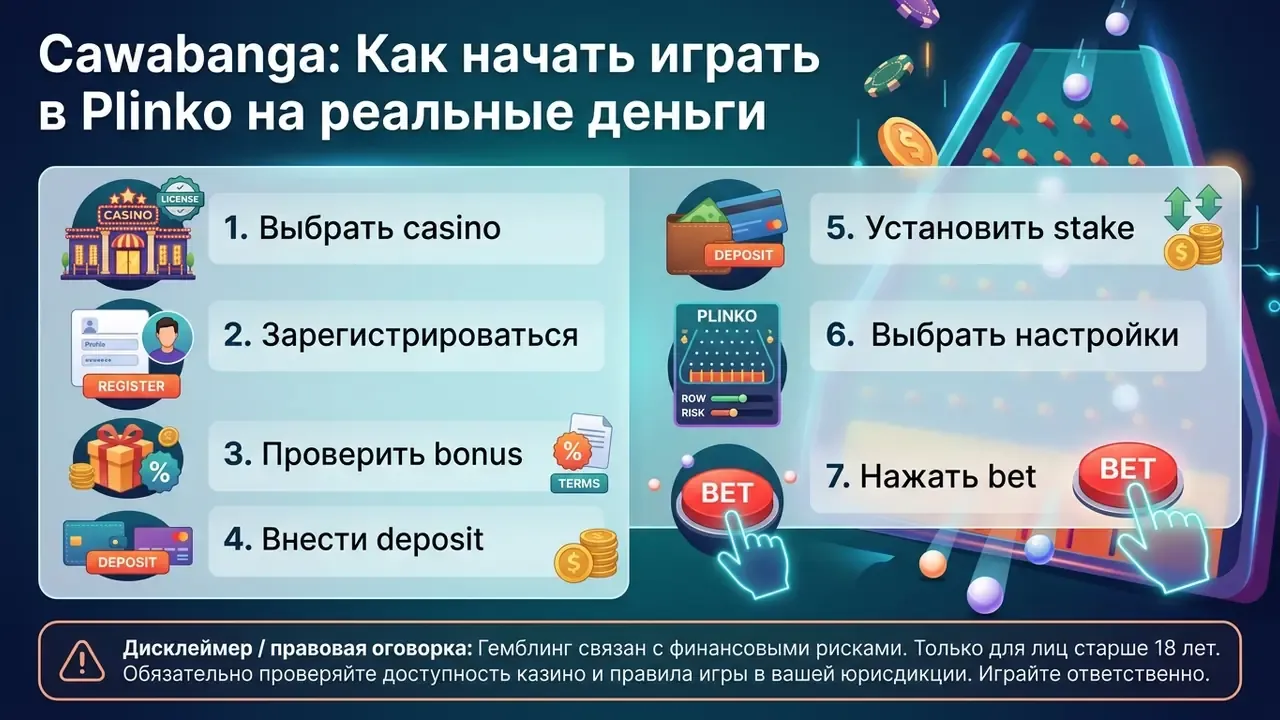
  5. Real-money play: casinos, bonuses, sweepstakes, mobile access and local rules
  6. Empirical evidence on simulated gambling and gambling harm
  7. Synthesis: what the research implies for Plinko players
  8. FAQ

1. What Plinko Is And How The Casino Game Works

Plinko is a single-player, instant-round casino format: you set a stake, choose a board configuration, release a ball from the top of a peg pyramid and receive whatever multiplier sits in the slot where the ball lands. There is no skill component, no decision after the release and no way to influence the trajectory once the round has started. That last point deserves emphasis, because most misleading advice about the game quietly assumes the opposite.

1.1 Physical and Mathematical Structure of Plinko Boards

Casino Plinko games are direct descendants of the Galton board, the classic laboratory device in which balls fall through offset pins and pile up in a bell-shaped heap.

«The Galton board demonstrates how random binary events generate a normal distribution, a foundational principle of probability theory.» Plinko Online: Mechanics, Demo Play, Real-Money Gambling, Risk Settings, and Evidence on Simulated Gambling (review study).

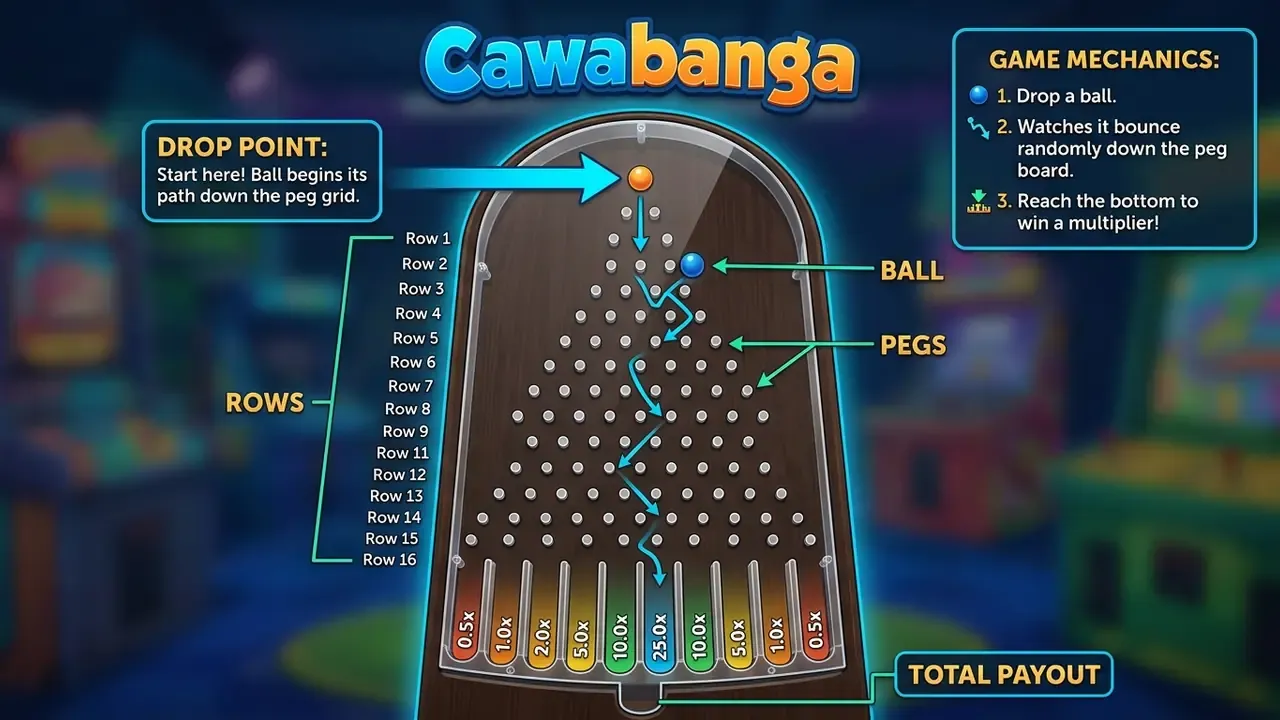
Structurally, every implementation contains three elements

Structurally, every implementation contains three elements:

  • Drop point. The ball is released from a single entry point above the centre of the peg field; commercial layouts depict this as the start of the descent.
  • Rows of pegs. Common designs use 8 to 16 rows (some studios ship 9-row and 12-row variants). Each row is one binary left/right decision, nothing more.
  • Bottom slots. Payout cells run symmetrically outwards. The lowest multipliers sit in the centre, the highest at the far left and right edges. Values in published versions range from roughly 0.2x to 1,000x and, in high-volatility builds, far beyond.

The televised ancestor of the format is The Price Is Right, where a puck was dropped through pegs into prize slots. That show established the drop-and-bounce mechanic that online studios later digitised.

1.2 Online Implementations, RNG, and Provably

1.2 Online Implementations, RNG, and Provably Fair Algorithms

Modern online Plinko products are implemented as RNG-based games rather than physical simulations: the landing slot is selected by a certified random number generator (or by a cryptographic hash chain), and the falling animation is a visual rendering of an outcome that has already been determined. If you want to compare current implementations side by side, the catalogue of online casinos with Plinko is a practical starting point.

Round pacing is one of the format's defining traits. Manual mode allows one ball per click; auto mode fires a preset number of balls in sequence, and some builds support multi-ball drops. Reported average round times of roughly 4.5 seconds where more elaborate animation is used are not currently backed by a published measurement methodology, so treat this figure as an operator-side estimate that requires independent data.

Volatility, by contrast, is measurable.

«The standard deviation of high-risk 16-row Plinko is around $6.80 per $1 ball, considerably higher than most slots, which sit in the $2–$6 range.» Plinko Online: Mechanics, Demo Play, Real-Money Gambling (mathematical analysis of Stake Plinko).

In practical terms: a $1 stake in the harshest configuration behaves like a small lottery ticket, not like a low-variance table bet. Different product, different expectations.

1.3 From The Price Is Right to iGaming in 2026

The transition from television prop to casino product happened in three stages: physical peg game, then arcade and pachinko-style amusement machines, then the RNG casino mini-game. By 2026, the standard online format is a browser or mobile mini-game with instant rounds, selectable risk levels, adjustable row counts and multiplier-based settlement, offered both in demo and real-money modes. Named suppliers of the format include BGaming, Spribe, Hacksaw Gaming and Gaming Corps, alongside numerous in-house builds on crypto-facing platforms.

[Note for readers] If you want to see the game before deciding anything, most platforms, including Casino, publish a demo build next to the real-money client, with the RTP and risk settings stated on the game page. Read the terms first, then pick a configuration that matches your bankroll.

1.4 Which Provider to Choose: BGaming vs Spribe vs Hacksaw

Not all Plinko games are equally generous. Provider choice directly determines your long-run return, and it is the one variable you fully control.

ProviderRTPMax multiplierRowsDistinctive feature
BGaming Plinko99%x1,000 (vendor game page)8–16Highest RTP in the category; manual/auto modes; results board
Spribe Plinko97%Configuration-dependent8–16Ball-colour selection (green / yellow / red) sets risk on the fly
Hacksaw Plinko94%3,843.3x8–16Extreme top-end volatility; 17 active slots at max rows
Gaming Corps Plinko / Xmas PlinkoTitle-dependentTitle-dependentFixed per titleSeasonal variants, jackpot integrations
1. BGaming Plinko a record 99
  1. BGaming Plinko: a record 99% RTP, released 28 January 2019, classified as a Casual game. Suited to low-risk grinding and to clearing bonuses where Plinko is eligible.
  2. Spribe Plinko: 97% RTP; risk is switched by picking the ball colour rather than a dropdown, which some players find faster and others find too easy to change mid-session.
  3. Hacksaw Plinko: 94% RTP, compensated by a top payout of 3,843.3x on 16 rows at high risk. At £10 average staking, the long-run expected return is £9.40 per £10.

Discrepancy note: BGaming's public game sheet lists a max multiplier of x1,000, while other BGaming materials cite figures up to x5,000 for the title family and an RTP of "up to 99%". Always confirm the paytable inside the specific casino build you are playing, because operators can license reconfigured RTP versions.

1.5 How to Verify Fairness Step

1.5 How to Verify Fairness Step by Step (Provably Fair)

Every drop in a Provably Fair Plinko is mathematically determined before the animation plays:

  1. The server generates a Server Seed and publishes only its SHA-256 hash, a cryptographic commitment: the value is locked, but hidden.
  2. Your client supplies a Client Seed (auto-generated, or manually entered by you).
  3. A nonce increments with each round, so identical seeds still produce different results.
  4. The path is derived from HMAC_SHA256(Server_Seed, Client_Seed + Nonce); the resulting bytes are converted into a sequence of left/right steps.
  5. After the seed rotation, the platform reveals the unhashed Server Seed. You hash it yourself in any independent SHA-256 calculator and compare it with the commitment shown before the round.
  6. If the hashes match and the recomputed path equals the observed path, the round was not manipulated.

Two caveats matter. First, Provably Fair proves integrity, not generosity of the paytable: a verified 94% RTP game is still a 94% RTP game. Second, verification does not enable prediction. Without the secret Server Seed the next outcome is not derivable, and regulated RNGs are specifically tested for unpredictability. Any "Plinko predictor script" or "hack" sold online is, by construction, unable to do what it claims. If someone promises otherwise, that is a sales pitch, not mathematics.

2. Gameplay Flow: Demo Plinko, Free Play, and Real-Money Rounds

2.1 Demo and Free Modes in Online Plinko

Most studios, including BGaming, publish a demo build that runs on virtual credits, usually without registration. Plinko demo mode lets you test row counts, risk levels and staking rhythm before committing funds, which is genuinely useful for learning the interface and the pace of auto play.

There is, however, a documented catch: many of these games have inflated payout rates that are not maintained in the real-money version.

«Demo games on operator sites deliberately inflate payout frequency, shaping unrealistic expectations before players move to real money.» Literature review commissioned by the New Zealand Ministry of Health.

A practical free-mode testing algorithm 1

A practical free-mode testing algorithm:

  1. Run 50 balls at Low risk / 8 rows and record how often the result is below 1.0x.
  2. Repeat with Medium / 12 rows, then High / 16 rows, using the same ball count.
  3. Log the longest streak of sub-1x outcomes in each configuration. This, not the max win, is what will decide whether your bankroll survives.
  4. Compare the demo paytable numbers with the paytable in the real-money client. If they differ, the demo is not a valid rehearsal.

What can you actually verify for free? Risk level behaviour, number of rows, multiplier layout, bet-size controls, auto-play limits and how quickly the balance moves. That is a lot. It is simply not a forecast.

2.2 Empirical Evidence on Demo-Mode Effects

Experimental work shows that a favourable free-play experience changes subsequent behaviour with real money. In a controlled study, those who experienced the artificially favourable demo later made significantly higher bets in subsequent real-money play.

«214 participants who played an inflated demo slot placed significantly higher bets in real play, although session length did not differ.» Experimental study cited in the New Zealand Ministry of Health review.

Conversion is not driven by mere exposure to free play, but by how successful the player felt:

«Free-mode players were no more likely to migrate to paid play than controls; the only predictor of migration was perceived performance.» Reilly, T. (2024). PhD dissertation, University of Georgia.

In other words, the belief that one is doing well was the single predictor of migration. Not the free access itself.

Spending inside free-to-play environments is an even stronger signal:

«Social casino players who made micro-transactions were 8.16 times more likely to move to real-money online gambling within six months.» Kim et al. (2014), longitudinal study of 409 social casino gamers.

Engagement in micro-transactions, rather than time spent or number of sessions, was the only unique predictor of migration, with an odds ratio of 8.16.

2.3 Transition from Free Simulated Gambling to Real-Money Play

Population data point the same way. Young people who played games that simulated gambling at age 16 or 17 were significantly more likely, by about 40%, to gamble with real money at ages 18 or 19.

«An Australian longitudinal study of children found that young people who played simulated gambling games at 16–17 were 40% more likely to gamble with real money at 18–19.» Growing Up in Australia: The Longitudinal Study of Australian Children.

The mechanism most often cited is normalisation: simulated gambling makes the activity look like an ordinary entertainment product with no downside, especially for teenagers. That is also why iGaming platform regulation increasingly targets demo access, age verification and the visual similarity between free and paid builds.

Practical takeaway for the player: treat a demo session as an interface tutorial, never as a sample of expected returns, and re-verify the paytable the moment you switch to cash.

3. Risk Levels, Number of Rows, Multipliers, and Variance in Plinko

3.1 Binomial Distribution and Outcome Probabilities

Each row is one independent binary step, so landing probabilities follow the binomial law P(k) = C(n,k) · 2⁻ⁿ.

  • 8 rows: the central bucket is C(8,4)/2⁸ = 70/256 = 27.3%; a single edge slot is 1/256 = 0.39%.
  • 16 rows: the central bucket (8 rights, 8 lefts) has probability of about 0.196, nearly 20%; a single edge slot is 1/65,536 ≈ 0.0015%.

«On a 16-row board the central slot lands with ~19.6% probability, while each extreme slot occurs with a probability of ~0.0015%, roughly once in 32,768 drops if you count either edge.» Plinko Online: Mechanics (binomial distribution analysis).

RowsCentral slot probabilitySingle edge slot probabilityExpected frequency of one edge hit
827.3%0.39%~1 in 256 drops
1222.6%0.024%~1 in 4,096 drops
1619.6%0.0015%~1 in 65,536 drops

Convention note: implementations differ on whether a board is described as having 8–16 rows or 9–17 bins, so the index of the "central" slot shifts by one depending on the naming used by the studio.

3.2 How Risk Levels Reshape Multiplier Distributions

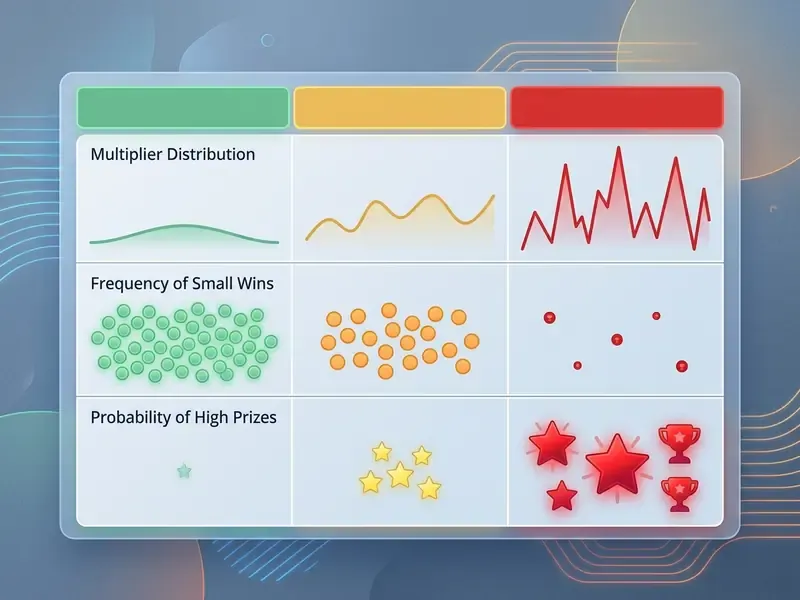
Risk settings in Plinko do not alter the underlying binomial landing probabilities. They reshape the distribution of multipliers assigned to each slot.

«The risk level in Plinko is purely a variance control: expected return stays fixed at the game's 97–99% RTP under any setting.» Plinko Online: Mechanics (technical analysis of Stake Plinko).

Low risk lifts the value of the easy central slots and caps the edges. High risk strips value from the centre and stacks it into the outer slots. The consequence, phrased without hyperbole: at high risk on 16 rows the modal outcome is a fractional multiplier, so long sequences of sub-1x results are the statistically expected behaviour of that configuration, not an anomaly or a rigged streak. On a 94% RTP build at high risk, most of the theoretical return sits in outcomes you may never see in a short session.

3.3 Full Payout Tables: 8, 12 and 16 Rows

Payout structure changes dramatically with configuration. Below is the complete multiplier schedule for the Hacksaw Plinko build, the most widely documented high-volatility version:

16 active rows (17 winning slots)

RiskWinning slot values (centre → edge)
Low0.9x, 1x, 1.1x, 2x, 5.2x, 32.7x, 501.3x
Medium0.7x, 0.8x, 0.9x, 1.5x, 3.1x, 15x, 100x, 1,718.7x
High0.3x, 0.5x, 0.9x, 2.1x, 6.8x, 32x, 238.9x, 3,843.3x

12 active rows

RiskWinning slot values
Low0.8x, 1x, 1.6x, 5x, 47.5x
Medium0.7x, 0.8x, 1x, 2.5x, 11.6x, 133.3x
High0.3x, 0.4x, 0.6x, 1.3x, 4.5x, 25x, 295.5x

8 active rows (9 winning slots)

RiskWinning slot values
Low0.9x, 1.2x, 4x
Medium0.7x, 0.9x, 2.4x, 12.6x
High0.4x, 0.5x, 0.9x, 3.3x, 27.1x

Consolidated risk matrix

Active rowsRiskWorst multiplier (centre)Best multiplier (edge)Max payout
8Low0.9x4.0x4.0x
8Medium0.7x12.6x12.6x
8High0.4x27.1x27.1x
12Low0.8x47.5x47.5x
12Medium0.7x133.3x133.3x
12High0.3x295.5x295.5x
16Low0.9x501.3x501.3x
16Medium0.7x1,718.7x1,718.7x
16High0.3x3,843.3x3,843.3x

Strategic nuance: at the mildest settings (8 rows, Low risk) the worst slot pays 0.9x, so you retain at least 90% of every stake. For anyone planning a long grinding session, that is the single most important number on the page. Documentation discrepancy: the same operator guide elsewhere quotes a 28.7x ceiling at 8 rows against the 27.1x listed in the paytable, so verify inside the client before sizing bets around the top slot.

3.4 Why Choose More Rows Or

3.4 Why Choose More Rows Or Fewer

Row count drives dispersion in a predictable direction. More rows create more possible trajectories, concentrate probability mass around the centre and push the extreme multipliers further out: the range widens while the edges become rarer. Fewer rows do the opposite, compressing the payout ladder and making the best available slot both smaller and noticeably more reachable.

A simple way to decide: pick the row count by the length of session you want, then pick the risk level by the drawdown you can tolerate. Eight rows at low risk is a slow, quiet grind with a 4x ceiling. Sixteen rows at high risk is a long wait punctuated by rare spikes, with a 0.3x floor doing most of the work in between.

[Note for readers] Unsure which risk level suits you? On Casino every Plinko configuration is available in demo mode, usually without registration, so the comparison costs nothing except time.

4. Plinko Strategy, Bankroll Management, and Limits of Progression Systems

4.1 What Actually Works Configured Setups

4.1 What Actually Works: Configured Setups, Not Secrets

No betting pattern changes RTP. What a Plinko strategy can do is control how fast your bankroll is exposed and how long you stay in the game. That is management, not an edge.

  • "Conservative conveyor" (low risk). Settings: 8 or 16 rows, risk LOW. Logic: on 8 rows the worst slot returns 0.9x, so hundreds of drops are possible with a shallow drawdown curve while you wait for the 4x (8 rows) or 501.3x (16 rows) edges. Recommended bankroll: 200 or more base stakes.
  • Adaptive Martingale on high risk. Settings: 16 rows, HIGH risk. Algorithm: fix a base stake (say $0.10). After any multiplier below 1.0x, double the stake. On any multiplier of 2.0x or higher, reset to base. Warning: this needs a bankroll of at least 100–150 base stakes, and the table or stake ceiling can still cut the sequence short at the worst possible moment.
  • "Volatility switching". Algorithm: 10 drops at Low risk (accumulating small returns), then 3 drops at High risk (an attempt at the outer slots), then reset the cycle. This does not improve expected value. It caps the number of high-variance drops per session, which is a discipline tool.
  • Fixed-fraction staking. Stake a constant percentage of the current bankroll (0.5–2%). This preserves risk proportionality but cannot repair a negative expectation: with a fixed house edge, the bankroll decays geometrically over a long enough series.
  • Mix and match. Switching rows and risk between rounds changes the shape of your results, never the average. Use it to find a rhythm you find comfortable, and log the sessions as you go.

Fact check on common claims. "Guaranteed win" systems do not exist for an RNG game. The ball's path cannot be predicted, not even with the full Provably Fair audit trail of previous rounds. Martingale does not remove risk; it relocates it into rarer, larger losses. And no configuration turns a 94% or 99% RTP into a positive expectation.

4.2 Martingale and Other Betting Systems: Mathematical Critique

Doubling after a loss looks unbeatable on paper because it hides the tail risk. For a binary Martingale, the stake after n losses is b·2ⁿ and the cumulative outlay before a win is b(2ⁿ⁺¹ − 1); with a finite table limit L, the maximum survivable streak is ⌊log₂(L/b)⌋. Plinko makes this worse, not better: outcomes are not binary 50/50. The board has many slots, sub-1x results dominate the centre at high risk, and a nominal "win" can still be smaller than the stake that produced it.

Simulation confirms the shape of the risk:

«A simulation of 10,000 Martingale sessions showed 94.3% ended with a small profit (+€23), but 5.7% wiped out the entire €200 bankroll; expected value: −€5.40 per session.» Casinokeller, analysis of the Martingale system in European roulette (2026).

«Martingale is mathematically elegant and practically lethal. It works, until it doesn't. And then the bankroll is gone.» Casinokeller (2026)

The Reverse Martingale (raising stakes after wins) inverts the distribution: many small losses, occasional large wins, identical expected value. Neither system alters the 1% (BGaming) to 6% (Hacksaw) house edge. Nothing does.

4.3 Responsible Gambling, Loss Limits, and Risk Communication

Disclaimer: This information is general in nature and does not replace advice from a qualified professional. Gambling carries a risk of financial loss. If you are struggling to control your gambling behaviour, contact a specialist support service.

Concrete controls that work better than

Concrete controls that work better than any staking system:

  1. Set a loss limit before the first drop, as a fixed cash figure, not a feeling.
  2. Set a session timer. Auto mode can fire hundreds of rounds in minutes, and instant-round games compress exposure dramatically.
  3. Use operator tools: deposit limits, loss limits, reality checks, cooling-off and self-exclusion. Regulated platforms are required to offer them.
  4. Never chase. A 3,843.3x slot with roughly 0.0015% probability per drop is not a recovery plan.
  5. Track everything. Log stake size, configuration, session length and net result. Perceived performance is a poor guide, as the research in section 2 shows.

5. Playing Plinko Online for Real Money: Casinos, Bonuses, Mobile Access and Local Rules

5.1 Choosing a Licensed Platform, KYC

5.1 Choosing a Licensed Platform, KYC, Limits and Payouts

Real-money terms are set by the operator, not by the game. Verification requirements, stake ranges and withdrawal rules are platform-specific and jurisdiction-dependent.

Selection criteria for the best Plinko sites, in order of importance:

  • Licence. A visible regulator-issued licence number and jurisdiction (for example MGA, UKGC, Curaçao). BGaming's own supplier licence, for reference, is issued by the Malta Gaming Authority (MGA/B2B/785/2020).
  • Original provider attribution. The Plinko title should name its studio in the lobby metadata. Clones with undisclosed maths are a red flag.
  • Provably Fair or certified RNG. Either a verifiable seed system or published RNG certification from a testing laboratory.
  • Published payout speed per method and currency, cross-checked against recent user reports.
  • Complaint patterns in reviews: withheld withdrawals, sudden account closures, bonus disputes.

Pre-deposit checklist

CheckWhat to confirm
FeesDeposit and withdrawal commissions per payment method
LimitsMin/max Plinko stake, per-round max bet, daily and monthly withdrawal caps
KYCWhich documents are required, and whether verification happens before or after the first withdrawal
SupportAvailability hours, response channels, whether live chat resolves payment queries
RTP versionThe paytable and RTP of the specific build hosted by that operator
5.2 Stake, Winnings and Betting Limits

5.2 Stake, Winnings and Betting Limits

Settlement in Plinko is simple arithmetic: your wager multiplied by the slot value. A $2 stake landing on 0.5x returns $1; the same stake on 32.7x returns $65.40. Two limits shape the experience more than the paytable does. First, the per-round maximum bet, which is often lower for arcade and crash-style titles than for slots. Second, the withdrawal cap, which can turn a rare edge hit into a payout paid out over several days.

Risk level and row count determine how the same average return is delivered: many small credits, or long droughts with occasional spikes. The expected value stays where the RTP puts it.

5.3 Bonuses, Wagering Requirements, and Plinko Eligibility

Arcade and crash-style titles are treated inconsistently in bonus terms. Depending on the casino, Plinko may contribute 0%, 50% or 100% to wagering, and it is sometimes excluded outright. Where it is eligible, low-risk configurations are often recommended for satisfying wagering requirements.

«Low-risk Plinko configurations deliver steady turnover with lower dispersion, reducing the chance of losing the bonus balance before the wagering requirement is met.» Plinko Online: Mechanics (operator wagering guidance).

Three terms to read before claiming anything:

  1. Contribution rate for Plinko and other crash games.
  2. Max bet per round while a bonus is active. Exceeding it typically voids bonus winnings.
  3. Withdrawal conditions: completed wagering, no max-bet breach, completed KYC.
5.4 Plinko Mobile and Download Browser

5.4 Plinko Mobile and Download: Browser or Application

Plinko is built in HTML5, so the browser version is functionally identical to app builds on iOS and Android: same paytable, same RNG, same risk controls. Apps can add push notifications, biometric login and smoother animation; browsers avoid store restrictions and any installation at all. A Plinko download is therefore optional rather than necessary, and on older Android handsets the browser build is often the lighter option. A direct, source-backed UX comparison between HTML5 browser play and native casino apps is not currently available in published literature, so treat the difference as convenience, not mathematics.

One caution about downloads: install only from the operator's own domain or an official store listing.

Third-party APK mirrors advertising "Plinko money hacks" are the classic distribution channel for malware and credential theft.

The access question, however, is a regulatory one. Easy, continuous access to gambling-like products via mobile devices increases risk of harm.

«Regulatory reviews of simulated gambling emphasise that easy mobile access to gambling-style products increases the risk of harm and demands robust age verification.» Government reviews of simulated gambling (New Zealand Ministry of Health commissioned review).

Disclaimer: This information is general in nature and does not replace professional advice. Access to gambling via mobile devices is governed by the legislation of the user's jurisdiction.

5.5 Local Rules and Payments The

5.5 Local Rules and Payments: The Bangladesh Context

For readers in South Asia, and Bangladesh in particular, the legal picture deserves a sober paragraph rather than a marketing one. Gambling law in the country rests on the colonial-era Public Gambling Act of 1867, supplemented by later restrictions on online activity, and the practical result is that most casino-style play sits in a prohibited or unregulated grey zone. There is no domestic licensing regime for online casinos, so the "licence" you see on an international site is issued elsewhere and offers no local protection.

Payments are the second friction point. Mobile financial services are the default way people move money here, yet gambling-related transfers routinely trigger blocks, reversals or account reviews, and any intermediary offering to "route" a deposit is a risk in itself. Add currency conversion, and the cost of a session rises before the first ball drops.

Our editorial position on this is deliberately narrow: we explain mechanics, mathematics and risks, we do not encourage anyone to play where the activity is restricted, and we treat sports coverage as the core of the portal rather than casino promotion. Check your jurisdiction first. Everything else is secondary.

5.6 Sweepstakes Plinko vs Real-Money Gambling

5.6 Sweepstakes Plinko vs Real-Money Gambling: GC, SC and Playthrough

In the United States, many Plinko apps operate as sweepstakes casinos rather than real-money gambling (RMG) sites. The distinction matters:
  • Gold Coins (GC):purely for entertainment, with no redemption value.
  • Sweeps Coins (SC) / Stake Cash:promotional entries that can be redeemed for prizes after meeting a playthrough requirement (commonly 1x to 3x).
  • RMG:you wager real currency directly, under a gambling licence, with cash withdrawals subject to KYC.
PlatformWelcome offerCurrenciesPromo codePlaythrough
Stake.us260K GC + 55 Stake Cash (+5% rakeback)GC / Stake CashPublisher-specific (e.g. DEADSPIN)3x
Real Prize100K GC + 2 SCGC / SCN/A1x
McLuck7,500 GC + 2.5 SCGC / SCPublisher-specific (e.g. DEADSPIN)1x
Jackpota7,500 GC + 2.5 SCGC / SCN/A1x
Sidepot.us10,000 coins + 1 cash entryDual-currencyN/APer T&Cs

Age gates differ by brand and state: some sweepstakes operators are 18+, others 21+, and several exclude specific US states entirely. Always confirm eligibility before registering.

6. Empirical Evidence on Simulated Gambling, Social Casino Games, and Gambling Harm

6.1 Longitudinal and Experimental Studies on Migration to Monetary Gambling

Across the peer-reviewed and government-commissioned literature, there is medium-strength evidence that simulated gambling is associated with gambling problems.

«A review of 20 Australian and international studies found medium-strength evidence linking simulated gambling with problem gambling, particularly for social casino games.» Australian Gambling Research Centre (AGRC), literature review 2022–2023.

Longitudinal designs converge on the same direction of travel: six longitudinal investigations found sequential associations between simulated gambling and later gambling participation.

«Six longitudinal studies recorded sequential associations between simulated gambling and subsequent real-money gambling participation, including the transition from adolescence to adulthood.» Hing et al. (2025), report on the convergence of simulated and monetary gambling.

6.2 Simulated Gambling, Problem Gambling, and Gaming Disorder

Adolescent samples show additive effects across product types: participation in each of the four simulated gambling formats contributed independently to an increase in problematic gambling symptoms.

«Participation in each of four types of simulated gambling independently increased problem gambling symptoms among adolescents, with money spent and time in-game positively associated with risk.» Peer-reviewed 2022 journal article on adolescents in simulated gambling (available via PubMed Central).

Notably, the risk gradient tracks spending and time, both of which are trivially easy to escalate in an auto-play Plinko session. One click sets 500 rounds.

6.3 Mechanisms: Normalisation, Skill Illusion, and Micro-Transactions

Three mechanisms explain the association. First, normalisation: simulated gambling games can make gambling appear safe and socially ordinary.

«Social casinos and demo modes reproduce the visual reinforcement and sound effects of real casinos, lowering perceived risk and normalising gambling among young people.» Hing et al. (2025) and government reviews of simulated gambling.

Second, the skill illusion: because the player chooses rows, risk level and timing, the interface implies agency in an outcome that is entirely determined by an RNG. Third, micro-transactions act as a behavioural bridge, and the 8.16 odds ratio reported by Kim et al. (2014) remains the strongest single conversion signal in the literature.

[Note for readers] If you want a platform with responsible-gambling tools, session limits and a stated RTP, the reference materials on iGaming explain what to check in the terms before registering.

7. Synthesis: What Research Implies for Plinko Demo and Real-Money Play

7.1 Lack of Plinko-Specific Studies and Use of Analogous Evidence

There is currently no published study dedicated specifically to Plinko. The evidence base comes from analogous products, namely social casino games, demo slots and simulated gambling apps, which share Plinko's key features: instant rounds, adjustable risk, free-play availability and multiplier-based reinforcement. Within that literature, perceived performance is a key driver of conversion from free play to cash play in skill-adjacent games.

«A randomised study showed that the mere availability of a free mode does not increase conversion to paid play. Perceived player success is the decisive factor.» Reilly, T. (2024). PhD dissertation, University of Georgia.

Applied to Plinko, that means a demo session that happens to hit a 501.3x edge slot is a behavioural risk factor, not a signal of skill. Fun to watch, though.

7.2 Key Insights for Plinko Players

Disclaimer: This information is general in nature and does not replace professional advice. Gambling can cause financial and psychological harm. If you notice signs of dependence, seek professional help.

1. RTP is the only durable
  1. RTP is the only durable edge you control. Choosing a 99% BGaming build over a 94% build cuts the long-run cost per unit staked by roughly five-sixths.
  2. Risk level is a variance dial, not a return dial. Expected value is fixed by the paytable.
  3. Edge multipliers are lottery-grade events. One extreme slot on 16 rows appears in roughly 1 of every 65,536 drops.
  4. The 0.9x floor at 8 rows and Low risk is the most bankroll-friendly configuration available in the format.
  5. Progression systems shift risk into the tail. 94.3% of Martingale sessions look fine; the 5.7% that do not remove the entire bankroll.
  6. Demo results are not a forecast. Where demos use the same paytables as real-money Plinko they can, in principle, convey the harshness of high-risk modes, but this remains an untested assumption: no empirical study has verified the fidelity of casino demo builds, and regulator-commissioned reviews document the opposite pattern of inflated demo payouts. Verify the paytable yourself.
  7. Verify, don't predict. Provably Fair lets you audit the past; nothing lets you forecast the next drop.

  1. FAQ