Online Roulette in 2026: Rules, Variants, House Edge, Game Formats and Betting Systems
Last updated: February 2026 · Reading time: ~18 minutes · 18+ / 21+ depending on jurisdiction

Last updated: February 2026 · Reading time: ~18 minutes · 18+ / 21+ depending on jurisdiction
The first roulette wheel was not built to take bets. It came out of the workshop of Blaise Pascal, the French mathematician and physicist, who around 1655 was trying to build a perpetual motion machine, a device that would keep spinning without any external source of energy. Physics won that argument. Pascal never got his perpetual motion; he got a smoothly rotating, precisely balanced wheel instead, and gambling houses recognised its value long before mathematicians did.
More than three and a half centuries later, roulette is the most cinematically over-exposed game in the casino. It carries the high-stakes scene in Casablanca, inside Rick Blaine's nightclub, and it puts James Bond at the table in Diamonds Are Forever. That visual shorthand, green felt, a bouncing white ball, a croupier's hand sweeping chips, is precisely why so many people can picture roulette without ever having understood a single bet on the layout.
This guide fixes that. It covers the mechanics of a round, the three main wheel configurations, every standard bet with its payout and its probability on both wheels, the exact arithmetic of the house edge, how RNG and live-dealer formats differ technically, what betting systems can and cannot do, and how to evaluate a platform before depositing anything.
In two sentences: roulette consists of a numbered wheel, a betting layout, a ball, and a dealer who opens and closes the betting window. Everything else, from variants to systems to formats, is a variation on that one loop.
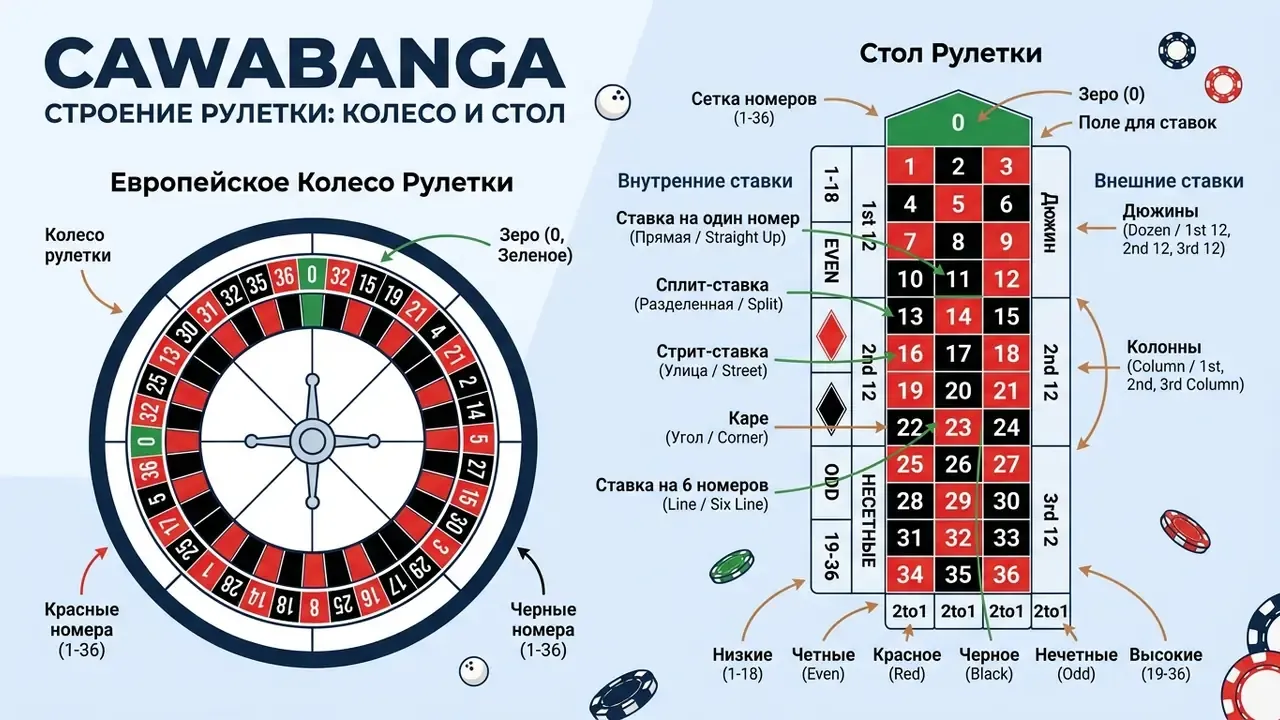
The roulette wheel is a rotating bowl with numbered pockets around its rim. Numbers 1 to 36 alternate red and black, arranged in a deliberately non-sequential order so that high and low, red and black, odd and even are spread as evenly as possible around the circumference. The zero pocket, and on an American wheel the double zero, is green. Green is not decoration: those pockets are neither red nor black, neither odd nor even, and neither high nor low, which is exactly where the casino's mathematical advantage comes from.
The roulette table layout (the green felt in front of the wheel) is the betting map. Numbers 1 to 36 are printed as a grid of 12 rows of 3, with 0 (and 00) at the head of the grid. Around the edges of that grid sit the outside betting boxes: red/black, odd/even, low (1–18) / high (19–36), the three columns, and the three dozens (1st 12, 2nd 12, 3rd 12). Every physical area of the felt corresponds to one mathematically defined group of numbers, which is why chip placement is the same thing as bet selection.
In a land-based casino, randomness comes from physics: wheel speed, ball speed, deflectors, pocket geometry. In an online casino the wheel is simulated by an RNG whose outputs are mapped to numbers and outcomes according to technical standards, and those standards are auditable rather than assumed.
«Regulators require that RNG scaling and shuffling algorithms be verified by independent laboratories for lack of bias and statistical independence.» Connecticut Department of Consumer Protection, Technical Standards (2024). https://portal.ct.gov/DCP
That is the practical difference between a licensed RNG table and an unlicensed one: not the graphics, but whether the algorithm has been tested for uniformity and independence by a third party such as GLI, eCOGRA, iTech Labs or BMM Testlabs.
A single round of roulette, online or offline, RNG or live, always follows the same sequence:
Two operational rules matter here. First, do not touch chips after betting closes. In live formats this voids the bet or triggers dealer intervention. Second, the result of step 4 has no memory: the pocket that just hit does not change the probability distribution of the next spin.
That "no memory" property is exactly where player behaviour diverges from mathematics. Behavioural studies on chasing confirm that although players often change their bets based on recent wins or losses, those adjustments cannot change the underlying odds, and roulette players adjust unusually aggressively.
«Roulette players showed the shortest return intervals to the platform, indicating the most intensive chasing behaviour among all games studied.» Hodgins et al., Journal of Behavioral Addictions (2024). https://doi.org/10.1556/2006.2024
| Term | What it means |
|---|---|
| Pill | The ball itself; casino jargon for the small ivory-substitute sphere dropped into the wheel. |
| Croupier / dealer | The person who spins the wheel, calls the result and settles chips. In live online roulette, a real human in a studio. |
| Layout | The printed betting surface on the felt. |
| Inside bets | Wagers on individual numbers or small clusters inside the number grid. |
| Outside bets | Wagers on large groups: colour, parity, range, dozen, column. |
| Call / announced bets | Wheel-sector bets (Voisins du Zéro, Tiers, Orphelins, Neighbours) declared verbally or via a racetrack panel. |
| Table limits | The minimum and maximum stake permitted per bet position and per round. |
| La Partage / En Prison | French rules that soften the loss of even-money bets when zero lands. |
In two sentences: all different roulette variants differ in one decisive respect, namely how many zero pockets exist and what happens to even-money bets when zero lands. Everything else (graphics, side bets, speed) is presentation.

The European wheel has 37 pockets: 1 to 36 plus a single 0. Every pocket is equally likely, so the probability of any specified number is 1/37 ≈ 2.7027%.
The edge appears in the payout gap. A straight-up win pays 35:1, but true odds are 36:1. Formally, expected value per unit staked is:
EV = (1/37 × +35) + (36/37 × −1) = −1/37 = −2.7027%
That −2.70% is identical for every standard bet on a European wheel: straight-up, split, column, red/black. Changing bet type changes how often you win and how much you win, never the expectation. This matches industry-standard figures for european roulette, but here it is grounded in formal mathematical modelling rather than repetition.
«The single-zero model formalises each bet as a probabilistic event, deriving expected profit and house advantage for all bet types.» Venkatesh & Gomathi Bhavani, Springer (2023). https://doi.org/10.1007/springer-roulette-2023
The American wheel adds a 00 pocket: 38 pockets in total, and a different number sequence around the rim. Payouts, however, are unchanged. A straight-up still pays 35:1.
That single extra green pocket doubles the margin:
EV = (1/38 × +35) + (37/38 × −1) = −2/38 = −5.2632%
American roulette also carries a bet that exists nowhere else: the five-number bet (0, 00, 1, 2, 3), paying 6:1. Its house edge is 7.89%, the worst standard wager on the table and the one bet mathematically literate players avoid without exception.
It is sometimes claimed that American tables offer higher limits or exclusive side bets that make them attractive for progression players. Limits and side-bet menus vary by operator and studio; they are not a property of the American wheel itself. Where higher ceilings do exist, they do nothing to offset a 5.26% edge, because a larger permitted stake simply multiplies the same negative expectation. Verified data on cross-operator limit distribution would be required before treating this as a general rule.
French roulette runs on the same 37-pocket single-zero wheel as european roulette. The difference lives in two rules that apply to even-money bets only (red/black, odd/even, high/low):
Either rule halves the even-money house edge exactly:
2.7027% ÷ 2 = 1.3513% ≈ 1.35%
French tables also standardise call bets, racetrack wagers organised by wheel sector rather than by grid position: Voisins du Zéro, Tiers du Cylindre, Orphelins, and Neighbours. These are convenience groupings of straight-ups and splits, and they carry the standard 2.70% edge.
Mini roulette uses a reduced wheel: 0 plus numbers 1 to 12, so 13 pockets. Payouts are scaled down proportionally (straight-up typically 11:1), which pushes the house edge to roughly 7.69%, or about 3.85% at tables that return half of even-money stakes when zero lands. Faster, simpler, and mathematically far more expensive per spin than european roulette.
Other online roulette games, including multi-wheel, multi-ball, lightning or multiplier roulette and immersive camera versions, change presentation, speed or the payout structure of straight-ups in exchange for random multipliers. Whenever a variant adds a bonus feature, check the published RTP: multiplier mechanics are usually funded by cutting the base straight-up payout, for example 29:1 instead of 35:1.
| Parameter | European | American | French | Mini |
|---|---|---|---|---|
| Pockets | 37 | 38 | 37 | 13 |
| Zeros | 0 | 0 and 00 | 0 | 0 |
| Straight-up payout | 35:1 | 35:1 | 35:1 | 11:1 |
| House edge (standard bets) | 2.70% | 5.26% | 2.70% | ~7.69% |
| House edge (even-money) | 2.70% | 5.26% | 1.35% | ~3.85% (half-back) |
| RTP equivalent | 97.30% | 94.74% | 98.65% (even-money) | ~92.31% |
| Special bet | — | Five-number (7.89% edge) | Call bets / racetrack | — |
| Special rules | — | — | La Partage, En Prison | Half-back on zero (varies) |
| Loss per $100 wagered (avg.) | $2.70 | $5.26 | $1.35 (even-money) | ~$7.69 |
Every figure above is derived from pocket count and payout, not from marketing material, so the comparisons rest on transparent and replicable calculations. Variant availability, published RTP and permitted rule sets are also shaped by licensing frameworks across the iGaming industry, which is why the same casino roulette title can carry different rules in different jurisdictions.
In two sentences: every roulette wager belongs to one of two families, inside bets on specific numbers and outside bets on large groups. Chip position on the felt defines the bet; nothing is declared except call bets.
Inside bets are what most players picture when they picture roulette, and their reward structure is not behaviourally neutral. High-payout positions appear to feed engagement rather than judgement.
«Game structural characteristics and session metrics jointly explained 26% of variance in games played per session in operator data.» Braverman et al., peer-reviewed (2023).

Note that 0 and 00 belong to no outside bet. Every outside wager loses when a green pocket hits, unless French rules apply.
Outside bets such as red/black and odd/even are commonly presented as a starting point for newcomers, because they resolve more often and produce lower variance per round, which makes the flow of the game easier to learn. That is a statement about variance, not about profitability. Expected loss per unit staked is identical to a straight-up bet on the same wheel. Empirical data specifically evaluating beginner outcomes by bet type is not available and would be needed to support a stronger claim. What is documented is that live table games including roulette are not perceived as low-risk products.
«More than half of respondents rated online casinos, table games and EGMs as high-risk gambling forms, correlating with problem gambling indicators.» Survey on perceived riskiness and problem gambling (2023).

The sequence online is short and worth rehearsing in demo first. Choose a chip value from the denomination tray. Click or tap the position on the felt: the centre of a square for a straight-up, the border for a split, the outer edge for a street. Use repeat, double and undo controls rather than re-clicking under time pressure, because misplaced chips are still valid chips.
Then check three things before the timer runs out: total stake shown on screen, the minimum and maximum per bet position (not per round), and whether the racetrack panel is active if you intend to use call bets. Confirm, and wait. Once the layout locks, nothing can be changed.
These are shortcuts for placing multiple straight-ups and splits at once. They cover more of the wheel per round, they raise total stake per spin, and they leave the house edge unchanged at 2.70%.
| Bet | Numbers covered | Payout | Win chance (European, 37) | Win chance (American, 38) | Edge EUR / USA |
|---|---|---|---|---|---|
| Straight Up | 1 | 35:1 | 2.70% | 2.63% | 2.70% / 5.26% |
| Split | 2 | 17:1 | 5.41% | 5.26% | 2.70% / 5.26% |
| Street | 3 | 11:1 | 8.11% | 7.89% | 2.70% / 5.26% |
| Corner | 4 | 8:1 | 10.81% | 10.53% | 2.70% / 5.26% |
| Five-number | 5 | 6:1 | — | 13.16% | — / 7.89% |
| Six Line | 6 | 5:1 | 16.22% | 15.79% | 2.70% / 5.26% |
| Column | 12 | 2:1 | 32.43% | 31.58% | 2.70% / 5.26% |
| Dozen (1st/2nd/3rd 12) | 12 | 2:1 | 32.43% | 31.58% | 2.70% / 5.26% |
| Red / Black | 18 | 1:1 | 48.65% | 47.37% | 2.70% / 5.26% |
| Odd / Even | 18 | 1:1 | 48.65% | 47.37% | 2.70% / 5.26% |
| Low / High | 18 | 1:1 | 48.65% | 47.37% | 2.70% / 5.26% |
| Even-money, French rules | 18 | 1:1 | 48.65% | — | 1.35% / — |
Read the table horizontally, not vertically: probability rises as payout falls, and the product of the two lands on the same negative expectation in every single row. That invariance is the whole mathematics of roulette.
Disclaimer: This information is general in nature and does not replace professional advice. Gambling involves financial risk; if you are struggling to control your gambling behaviour, seek professional help.
In practical money terms, over a large number of spins at $10 per round, the long-run average loss per 100 spins is about $27 on a European wheel, $53 on an American wheel, and $13.50 on French even-money bets. Nothing in the short run is guaranteed to resemble those numbers, that is variance, but nothing in the long run escapes them either.
A widely circulated error worth naming: several roulette guides state that the European house edge is "2.63%". It is not. 2.63% is the probability of hitting a specified number on an American wheel (1/38). The European edge is 2.70%; the American edge is 5.26%. A related error prints the French-rule edge as "1.4%", when the correct value is 1.35%, because halving 2.7027% yields 1.3513% exactly.
If two tables sit side by side with identical stakes, identical payouts and identical rules except for one extra green pocket, the choice is arithmetic rather than preference. Picking French or european roulette over american roulette is a transparent way to reduce the house advantage: it cuts expected loss per unit staked roughly in half, and by roughly 75% for even-money bets under La Partage. This is the single highest-value decision a roulette player makes, and it is made before the first chip is placed, which is why table selection deserves as much attention as choosing an online casino in the first place.
It is often asserted that French-rule tables are rare. Availability of La Partage and En Prison varies substantially by operator, live-studio provider and jurisdiction, and no reliable cross-market census of table availability exists. The practical instruction is therefore procedural rather than statistical: open the game rules panel and check whether La Partage or En Prison is listed before betting, because the rule, not the game's name, determines the 1.35% figure.
A payout of 35:1 sounds like an opportunity. It is a price. The casino pays 35 units where fair odds would require 36 (European) or 37 (American), and the entire business model of roulette lives in that one-unit difference.
This has a hard consequence for strategy: payout structures and probabilities, not betting patterns, determine expected losses.
«The long-run ratio of profit to total amount bet converges almost surely to −1/74, independently of the progression system applied.» «Long-term behavior of casino games», arXiv preprint (2026). https://arxiv.org/abs/2026-casino-games
Worth restating plainly. Staking systems change the shape of your results, how often you win, how large the swings are, how quickly a bankroll can vanish, and leave the destination unchanged.
Player behaviour, however, does respond to payouts and losses in measurable ways. Within sessions, the chasing research finds that gamblers bet more and play longer straight after losses.
«Players increased bet sizes and extended sessions after immediate losses, but reduced stakes as cumulative losses accumulated.» Hodgins et al., Scientific Reports (2024). https://doi.org/10.1038/s41598-2024
The practical reading: the most expensive mistake in roulette is not choosing the wrong bet type, it is increasing stake size in reaction to a losing streak.
Claim: "Red has hit eight times in a row, so black is due." Status: false. Each spin is an independent event. On a European wheel the probability of black remains 18/37 regardless of history. The wheel has no memory, the RNG has no memory, and the ball has no memory. Believing otherwise is the gambler's fallacy, and it is the psychological engine behind most loss-chasing.
Claim: "Online roulette results are manipulated in real time against the player." Status: unsupported for licensed operators. Licensed RNG games are subject to independent laboratory testing for bias and statistical independence, and results must be generated before any display animation. In live-dealer roulette, standards require non-magnetizable balls, regular inspections, and strict limits on ball use.
«Roulette balls must be manufactured from non-magnetic material and replaced no later than after 100 hours of live dealer use.» Connecticut Department of Consumer Protection, Live Dealer Technical Standards (2023). https://portal.ct.gov/DCP
Claim: "Tracking a physical wheel's bias can beat live roulette." Status: theoretically possible, practically negligible online. Bias exploitation requires thousands of logged spins from one specific wheel, mechanical imperfection that persists, and no wheel maintenance or rotation. Studio wheels are inspected, balanced, rotated and ball-replaced under the standards above. Treat wheel-bias services sold online as marketing.
Disclaimer: This information is general in nature and does not replace advice from a responsible-gambling specialist. Play only with money whose loss would not affect essential expenses, and only where online play is lawful for you.
Demo mode loads the same RNG game with a virtual balance. No deposit, no withdrawal, no financial exposure. It is genuinely useful for three things: learning where chips go on the layout, learning the interface (chip denominations, repeat-bet, undo, double, racetrack panel), and watching how a staking pattern behaves across a sample of spins.
Its limitation is equally clear: demo removes money, and money is the variable that changes decision-making. Free roulette play cannot reduce variance, cannot validate a system, and cannot reproduce the psychological conditions of real-money play. A progression that "worked" across 200 demo spins has demonstrated nothing except that 200 spins is a small sample.
Real money roulette on RNG tables is the fastest format: rounds resolve in seconds, minimum stakes often start around $0.10–$0.50, and there is no waiting on a dealer. Speed is the hidden cost. House edge applies per spin, so a format that delivers three times as many spins per hour delivers three times the expected loss per hour at the same stake.
Practical controls before you start: set a deposit limit, a loss limit and a session-time limit at account level; confirm the game's published RTP; and check the table minimum and the betting limit per bet position, since maximums for money bets are often set per position rather than per round.
Live roulette is a real physical wheel in a studio, or on a casino floor, streamed to your device, with bets placed through a software overlay. The result comes from the physics of a ball landing in a pocket, not from an algorithm. Here is what sits behind the stream:
The trade-off is round speed: live tables typically deliver 25–40 spins per hour against 60–120+ for RNG tables. Slower play with identical mathematics means lower expected loss per hour, which makes live dealer roulette, counter-intuitively, the more conservative real-money format at equal stakes.
| Criterion | Demo (RNG) | Real Money (RNG) | Live Dealer |
|---|---|---|---|
| Financial risk | None | Yes | Yes |
| Result source | RNG | RNG | Physical wheel + OCR |
| Social element | None | None | Real dealer, chat, shared table |
| Rounds per hour | Very high | 60–120+ | 25–40 |
| Typical minimum stake | Virtual | $0.10–$0.50 | $1–$5 |
| Typical maximum stake | n/a | Moderate | High, up to $10,000+ on VIP tables |
| Connection requirements | Low | Low | Stable, higher bandwidth (HD video) |
| Best suited to | Learning layout and interface | Fast solo play, low stakes | Atmosphere, slower paced play |
| Expected loss per hour | Zero | Highest (speed) | Lower (speed) |
In short: demo for learning the felt, RNG for cheap and fast solo rounds, live for atmosphere and a slower clock. None of the three changes the edge.
Platform safety is not a matter of trust; it is a matter of verifiable documents. Work through this list before depositing.
Immediate red flags: withdrawal times measured in months; accounts closed without notice; licensing claims that cannot be found on any register; support that will not answer questions about wagering terms in writing; pressure to deposit through unverifiable channels.

Expert alert: No roulette strategy eliminates the house edge or guarantees profit. Regulators are explicit that gambling is never a reliable way to make money, and problem-gambling bodies state directly that no betting system can overcome the house advantage. Staking progressions change variance, not expectation, and they must never be treated as a way to recover losses.

Martingale. Double the stake after every loss on an even-money bet; one win recovers all prior losses plus one unit. After n consecutive losses the next required stake is 2ⁿ × base. From $10: $10, $20, $40, $80, $160, $320, $640, $1,280, $2,560. Nine losses in a row on a European wheel, probability roughly 1 in 380 sequences, require $5,110 staked to win $10. The system fails at the table maximum, not in theory.
Fibonacci. Move one step forward in the sequence (1, 1, 2, 3, 5, 8, 13, 21…) after a loss, two steps back after a win. Growth is slower than Martingale, so the bankroll survives longer, but the same wall arrives. Later, and just as hard.
D'Alembert. Increase the stake by one unit after a loss, decrease by one unit after a win. Bankroll demand grows linearly, which makes it the gentlest of the four and the slowest to recover a long losing run.
Labouchère (cancellation). Write a sequence summing to your target profit; bet the first plus last numbers; on a win, cross both off; on a loss, append the amount lost to the end. Sequence length grows during losing runs, and with it the required stake.
| System | Progression | Bankroll growth | Fails when | Edge after use |
|---|---|---|---|---|
| Martingale | ×2 after loss | Exponential (2ⁿ) | Table max or bankroll exhausted | 2.70% |
| Fibonacci | +1 step after loss | Near-exponential | Long losing streak | 2.70% |
| D'Alembert | +1 unit after loss | Linear | Slow recovery, drift down | 2.70% |
| Labouchère | Sum of ends | Sequence-length driven | Sequence inflation | 2.70% |
| Flat betting | None | None | — | 2.70% |
All five rows end identically, because expectation is a property of the wheel, not of the staking plan.

A commonly used coverage pattern: stake $10 on the 1st dozen (pays 2:1) and $10 on Black (pays 1:1). Together this covers 24 of 37 numbers, with overlap on the black numbers inside 1–12, which produces a double win on those hits. Outcomes per round on a European wheel:
This produces frequent small results and rarer larger losses. Total stake per round is $20, and expected loss is $20 × 2.70% = $0.54 per spin. Same edge, simply redistributed. Use it to shape session texture, not to expect profit.
This is the part of "strategy" that genuinely changes outcomes, because it changes how much you expose and for how long.
1. Betting on every number. Can you place a chip on all 37 numbers? Yes. Should you? The arithmetic answers instantly. At $1 per number you stake $37. One number wins, paying $35 plus the $1 winning stake returned, so $36. Every spin, guaranteed: −$1. On an American wheel with 38 numbers the guaranteed loss is −$2. Full coverage does not remove risk; it converts a random loss into a certain one.
2. Playing american roulette when European is available. Same payouts, double the edge. This single choice costs more over time than any betting system can theoretically recover.
3. Taking the five-number bet. 7.89% edge. The worst wager on any standard layout.
4. Chasing losses. Documented as the strongest behavioural risk marker in roulette specifically, with the shortest platform return intervals of any studied game.
5. Ignoring table limits. A progression is only viable within the maximum. Check the per-position maximum before planning any doubling scheme; most Martingale failures are limit failures.
6. Confusing frequency with profitability. Red/black wins 48.65% of the time; a straight-up wins 2.70% of the time. Both lose 2.70% of every unit staked.
7. Treating demo results as validation. Small samples produce winning streaks routinely. A profitable 200-spin demo run proves the sample was short.
8. Playing emotionally. Anger, boredom, alcohol and fatigue all raise stake size. If any of those are present, the correct bet size is zero.
9. Reading spin history as a signal. Displayed "hot" and "cold" numbers are a UX feature, not information. Independence means history carries no predictive content.
10. Depositing before reading bonus terms. Roulette is frequently excluded from wagering contribution or weighted at 5–10%, which can make a bonus mathematically unplayable on roulette.
This article is informational and does not constitute legal or financial advice. Gambling law is territorial and it changes; verify the current position in your own jurisdiction before acting.
In Bangladesh, gambling is restricted under the Public Gambling Act 1867, which remains the principal statute. There is no domestic licensing regime for online casinos, so any online roulette offered to Bangladeshi residents comes from offshore operators outside local regulatory oversight. Practical consequences follow directly from that:
This guide explains how roulette works mathematically and technically. It does not encourage circumventing blocks, laws or payment restrictions.
If gambling has stopped being entertainment, stop playing and seek professional support. That is the only strategy in this article with a proven positive expected value.
| Claim as commonly published | Verdict | Correct figure / clarification |
|---|---|---|
| "The house edge on European roulette is 2.63%." | Incorrect | European edge = 1/37 = 2.7027% ≈ 2.70%. The figure 2.63% is the probability of a straight-up win on an American wheel (1/38). |
| "The American house edge is half that of Europe." | Reversed | American = 2/38 = 5.26%, i.e. roughly double the European 2.70%. |
| "La Partage / En Prison lowers the edge to 1.4%." | Imprecise | Halving 2.7027% gives 1.3513% ≈ 1.35% on even-money bets. |
| "En Prison lowers the edge on all bets." | Needs clarification | It applies only to even-money bets (red/black, odd/even, high/low). Inside bets remain at 2.70%. |
| "Live dealer results are determined by the bounce of a physical ball rather than an algorithm." | Supported | Correct. The physical outcome is digitised by OCR cameras and wheel sensors, then settled by the platform. |
| "Straight Up pays 35 to 1." | Supported | Correct: 35:1 plus return of the original stake, against true odds of 36:1 (European). |
| "You can put a chip on every number and win something." | Misleading | You win one bet and lose 36 (or 37). Net result is a guaranteed loss of one unit (European) or two units (American) per spin. |
| "Betting the table minimum on outside bets covers 18/38 combinations." | Wheel-specific | 18/38 = 47.37% applies to American wheels. On European wheels it is 18/37 = 48.65%. |
This guide was produced by the editorial team behind our iGaming analysis desk, which covers casino mathematics, live-studio technology, licensing frameworks and player-protection standards. All house-edge and probability figures here are derived from first principles, pocket count and payout schedule, so that readers can reproduce every number independently. Regulatory and behavioural claims are attributed to their primary sources inline.
Editorial position: we publish mathematics and verifiable technical detail, not win promises. There are no guaranteed-profit systems in roulette, and any source offering one is selling something.
Content notice: informational only. Not betting, legal, tax or financial advice. 18+ / 21+ depending on jurisdiction. If gambling is causing you harm, contact BeGambleAware, Gambling Therapy or Gamblers Anonymous.